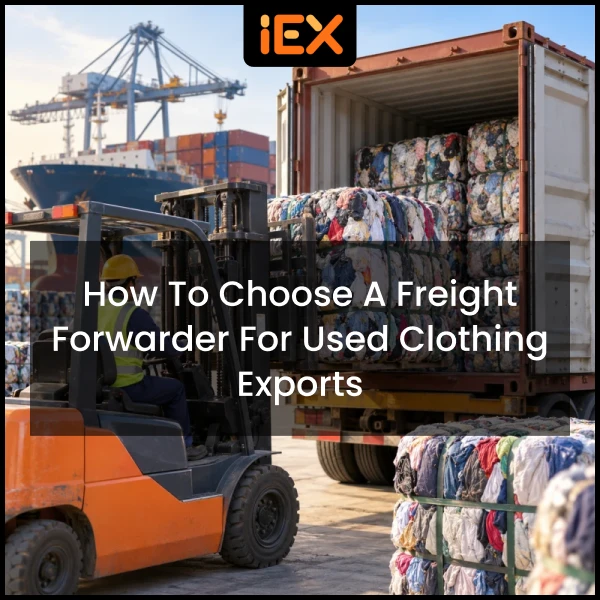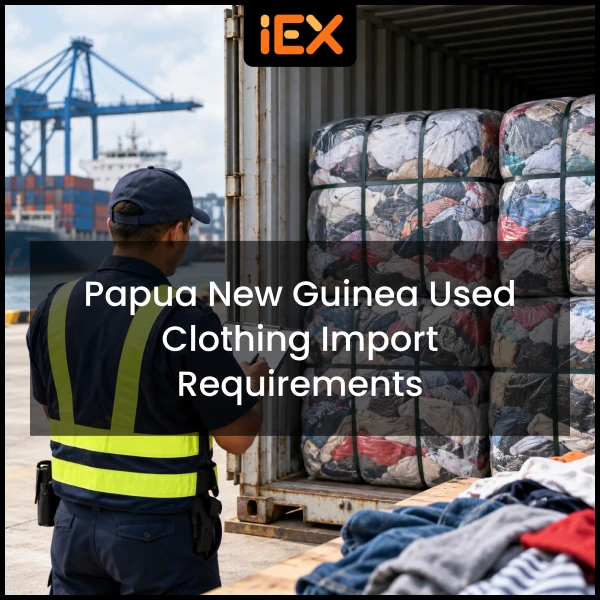
Buying secondhand clothes in bulk in Johannesburg is not simply a matter of finding the lowest advertised price. A reseller may be comparing a sealed bale collected in Kya Sands, jackets selected by weight in Alberton, coat bales available around Benoni, a sack delivered from another province, or an overseas order that can proceed only if the goods are legally eligible for import. Each route gives the buyer a different level of inspection, category control, working-capital exposure and claim protection.
The best first purchase is therefore the one that matches your current sales channel and can be verified before payment. Start with a local or delivered test when demand is still uncertain. Consider a remote commercial order only after you have sales records, a written product specification and confirmation that the intended goods can lawfully enter South Africa.
Quick Answer: Where to Buy Secondhand Clothes in Bulk in Johannesburg
Johannesburg buyers have four practical sourcing routes: local sealed-bale warehouses, local category or pick-by-weight distributors, Gauteng specialists serving a particular category such as coats, and nationwide-delivery wholesalers. Established businesses may also discuss overseas sourcing, but South African import eligibility must be confirmed before a deposit, production or freight booking.
If you want supplier names and current verification notes, use the Johannesburg clothing-bale supplier list. This page has a different job: it explains how to choose among those routes, what to verify during a test purchase and when a larger sourcing model becomes operationally sensible.
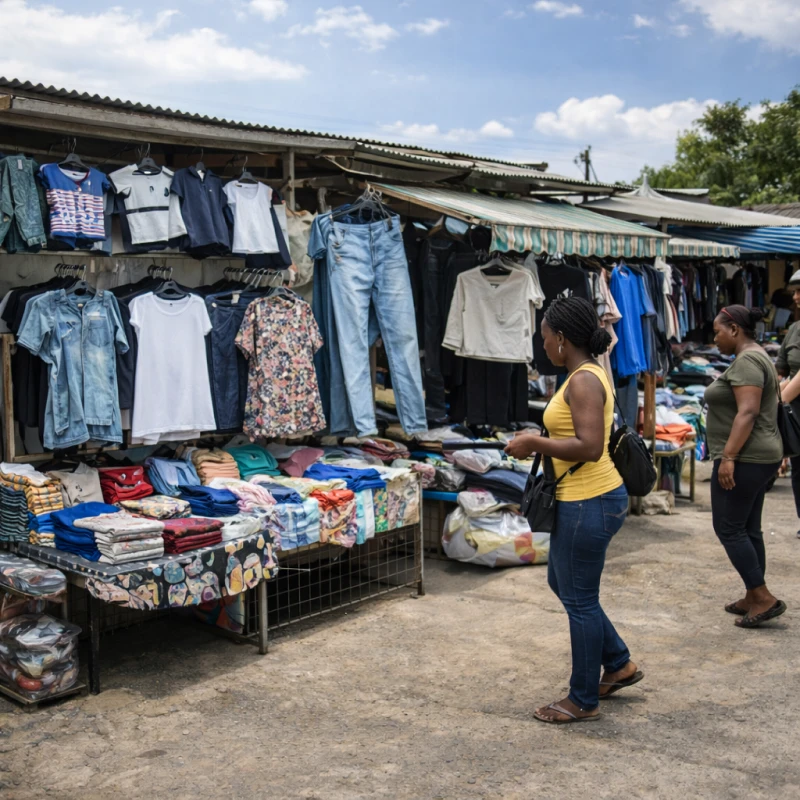
Johannesburg buyers should choose a sourcing route before comparing individual offers.
Start With the Buying Route, Not the Supplier Name
Two offers described as bulk secondhand clothing in Johannesburg may not be comparable. One seller may quote a sealed mixed bale that cannot be opened before purchase. Another may let you select visible jackets and charge by weight. A third may offer a handpicked sack delivered by courier. An exporter may quote a category-specific container, but that option adds legal, freight and receiving requirements that do not exist in a local pickup.
The route determines what you can inspect and what evidence is realistic. A walk-in buyer may check individual pieces, a bale label and the scale reading. A remote buyer needs a current invoice, order-linked images or video, written exclusions, delivery terms and a claim process. Asking every seller for the same evidence without recognizing the product format produces misleading comparisons.
| Buying route | Best suited to | What the buyer can usually control | Main limitation |
|---|---|---|---|
| Local sealed bale | A reseller testing demand with limited logistics | Bale category, stated weight, collection and external condition | Little visibility into exact sizes, styles and piece count before opening |
| Local pick by weight | A category-focused reseller who can inspect in person | Individual condition, category and selected pieces | Selection takes time; heavy garments reduce pieces per kilogram |
| Gauteng category specialist | A buyer with proven demand for coats, denim or another defined category | Product category and often a clearer use case | Seasonal stock and branch availability can change |
| Nationwide delivery wholesaler | A buyer outside convenient collection distance | Ordered pack type, destination and courier arrangement | Remote verification and claims are more difficult |
| Overseas commercial sourcing | An established buyer with legal eligibility and shipment capability | Written category, grade exclusions, bale and packing requirements | Permit, customs, freight, lead-time and working-capital exposure |
Use this table to remove unsuitable routes before discussing price. A small social-commerce seller who needs fifty photographable pieces may be better served by visible category stock than a random bale. A market trader who already knows which mixed categories turn quickly may accept more variation in exchange for faster replenishment.
Where Johannesburg Buyers Commonly Source Bulk Stock
Johannesburg's usable sourcing area extends beyond the CBD. Current search results and first-party supplier pages show local bale activity in Kya Sands, clothing distribution around Johannesburg and Alberton, and category-specific coat purchasing through Benoni and other Gauteng locations. Nationwide-delivery sellers also compete for Johannesburg orders even when their warehouse is in another province.
These locations should be treated as route indicators, not proof that every warehouse always has the advertised stock. Before travelling, ask whether the current offer is used clothing, new liquidation apparel or returns; whether it is sold as a sealed bale, by kilogram, by sack or per selected piece; and whether the named category is physically available that day.
Kya Sands and Local Sealed-Bale Collection
Kya Sands is relevant to buyers who want a local bale without arranging national freight or international shipping. A sealed-bale model provides a known collection point and a stated pack format, but it does not automatically provide a known size ratio, brand mix or exact garment count. The buyer should save the current listing and return terms before payment because those documents define what can be claimed later.
Ask whether the bale is full or half size, whether the stated weight includes packaging, which category label appears on the bale and what happens if the delivered category is wrong. If the seller's terms require a wrong-category claim while the bale remains sealed, photograph the label and external condition before opening it.
Johannesburg CBD and Social-First Sellers
The CBD and surrounding trading network can provide immediate access to bales and small wholesale lots. It can also produce more verification work because some sellers trade primarily through Facebook, WhatsApp, TikTok or marketplace listings. A social profile can help you discover an offer; it should not be the only reason to transfer money.
For an in-person purchase, confirm the shop or collection point and inspect the label, seal and scale reading. For delivery, match the invoice name, payment-account holder, telephone number and stated address. Ask for current evidence containing the product and an order reference, rather than relying on an old warehouse video that could belong to another seller or another batch.
Alberton and Category Stock Sold by Weight
Johannesburg and Alberton distributors may offer used jackets or coats as visible stock rather than as a general mixed bale. This route can reduce assortment risk because a buyer may be able to judge condition and choose pieces that suit the sales channel. The trade-off is time: selection, transport and the weight of heavier garments all influence the real unit cost.
Do not compare a per-kilogram jacket offer with a mixed-bale price until you estimate the number of saleable jackets and the labour required to select them. For an outerwear business, paying more per kilogram can still produce a better commercial result if the chosen pieces need less cleaning and match the selling season.
Benoni and Gauteng Outerwear Specialists
Benoni is especially relevant to resellers looking for coats and jackets rather than a broad mixed-clothing assortment. A category specialist can be useful when the buyer already knows the seasonal selling window and customer price band. It is less suitable when the business needs lightweight everyday stock throughout the year.
Call the branch before travelling and distinguish retail rack stock from wholesale bale stock. Ask whether the bale contains coats only, whether lighter jackets are included, whether a representative portion can be inspected and how the packed weight is recorded. The Johannesburg supplier list contains current route descriptions without turning this page into a second supplier ranking.
Decide What “Bulk” Means for Your Business
The phrase secondhand clothes wholesale in Johannesburg covers several different order formats. A sealed bale minimizes handling before purchase but increases assortment uncertainty. A handpicked sack provides more visible selection but usually involves more seller labour. Pick-by-weight stock lets the buyer inspect individual garments, while a category lot may sit between a curated sack and a fully random bale.
Write down the intended format before requesting quotes. If you ask only for “cheap bulk clothes,” sellers can respond with products that share a price unit but not a commercial purpose. A useful request identifies the sales channel, garment category, season, acceptable defects, preferred pack format and test quantity.
For example, an online seller may ask for photographable women's jackets with intact main closures and no active mildew. A market-stall buyer may prioritize everyday mixed clothing and a predictable restocking schedule. Neither request is inherently better; each creates a specification that can be checked against the offer.
Use a Small Test Purchase Before Scaling
A test purchase should answer a business question, not merely prove that a seller delivers something. Select one category and one selling channel, record the offer as it was described, and preserve the bale or lot identity when the goods arrive. Open and sort the stock before mixing it with existing inventory.
Use four receiving buckets: ready to sell, cleaning or minor repair, markdown or alternate channel, and reject. Record the count and processing time in each bucket. The goal is not to compare your result with an internet-wide “normal percentage”; it is to establish what this seller, category and pack format produced for your business.
Then track time to first sale, markdowns and unsold inventory. A bale with a low purchase price can become expensive if it requires extensive cleaning or does not match the season. A higher-priced category lot may be commercially stronger if it reaches the sales floor quickly. The clothing-bale sellable-percentage guide explains how to use receiving buckets without inventing a universal yield.
Compare Cost per Sellable Item, Not Advertised Price per Kilogram
Price per kilogram is useful only when the offers contain similar goods and include similar costs. For a local purchase, acquisition cost may include the goods, VAT where applicable, delivery or pickup fuel, washing, repairs and sorting labour. A delivered order also adds courier and claim costs. A legally eligible import adds freight, insurance, customs charges, brokerage, port handling and inland delivery based on current documents.
Use this formula after receiving a test lot:
Cost per first-pass sellable item = total acquisition and processing cost ÷ first-pass sellable item count
Do not insert generic online freight, duty or wastage percentages into this calculation. Use the seller's current invoice, a freight quotation, written tax treatment and your own receiving record. This converts a vague “cheap wholesaler” comparison into a business-specific decision.
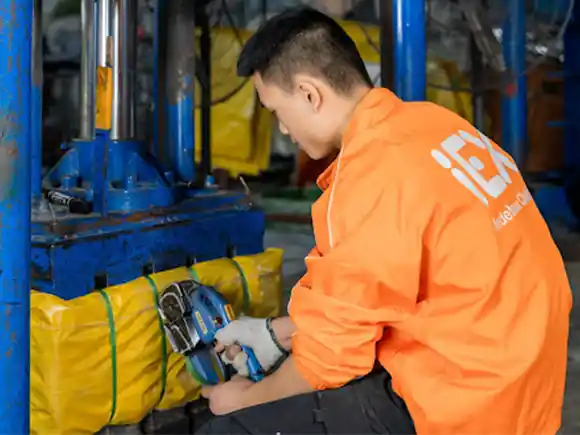
Record product weight, packaging and bale identity separately when comparing quotations.
Verify the Offer Before You Pay
Local pickup reduces some risks but does not remove the need for a written record. Remote delivery increases the importance of identity, product and claim evidence. Before payment, make sure the quotation answers the following questions:
- Are the goods used, returns, new liquidation stock, credential, sorted or graded?
- Is the offer a sealed bale, sack, selected lot or pick-by-weight stock?
- What is the named category, and which categories are excluded?
- What observable defects does the stated grade exclude?
- Is the weight gross packed weight or net garment weight?
- Is any piece count measured, estimated or not stated?
- Can the current goods or a representative sample be inspected?
- What is the claim deadline, required evidence and available remedy?
- Do the invoice, account holder, contact details and collection address match?
- Which delivery, tax and handling costs are outside the quoted price?
If several fields remain unanswered, the offer is not ready for comparison. The solution is not necessarily to reject the seller immediately; ask for clarification and decide whether the remaining uncertainty is acceptable for the size of the test.
Treat South African Import Eligibility as a Gate, Not an Assumption
South Africa tightly controls second-hand clothing imports. ITAC has stated that it generally does not grant import permits for second-hand goods, particularly clothing, except for specific and narrowly defined purposes. Separate tariff material describes a permit-linked provision for certain defined used overcoat categories. That limited pathway should not be interpreted as general permission to import mixed used-clothing bales.
Before paying an overseas supplier, give the intended product description, category and use to ITAC and a qualified South African customs broker. Confirm whether a permit is required and realistically available, and obtain the answer in writing. Do not ask a supplier to alter the description, use an inaccurate tariff code or route the shipment through another border to avoid the restriction.
This gate determines whether overseas sourcing belongs in your plan at all. If the proposed goods are not eligible, choose legally available local or delivered stock. If a specific category is eligible, put the permit conditions into the purchase specification before sorting, packing or shipment begins.
When an Indetexx Quotation Becomes Relevant
Indetexx is an overseas used-clothing exporter, not a Johannesburg walk-in wholesaler. Its role becomes relevant only when a buyer has confirmed a lawful destination and product category and is ready to compare a commercial remote order with local supply. At that point, the useful conversation concerns the current category, Grade A/B/C exclusions, bale weight, packing requirements and 20ft or 40ft shipment planning.
Send a written brief rather than asking for the “best Grade A clothing.” The used clothing bale specification-sheet guide shows how to define category, exclusions, weight, packing and required evidence. Indetexx's 20,000 m² self-owned factory supports order-specific sorting discussions, but factory scale does not guarantee a shipment's sellable yield, category ratio, profit, lead time or legal admissibility.
When the goods are received, report results by bale or lot using the same categories and exclusions from the order brief. That feedback is more useful for a repeat-order discussion than a general complaint that the second shipment “felt different.” The buyer's receiving record and the supplier's current specification must remain linked.
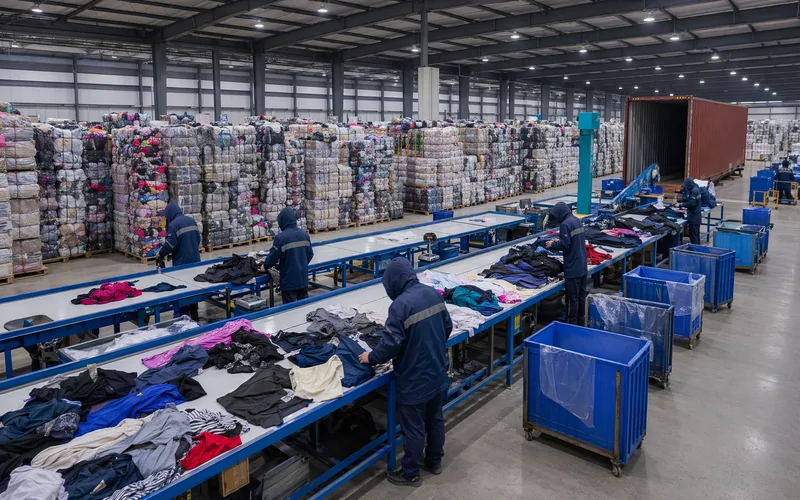
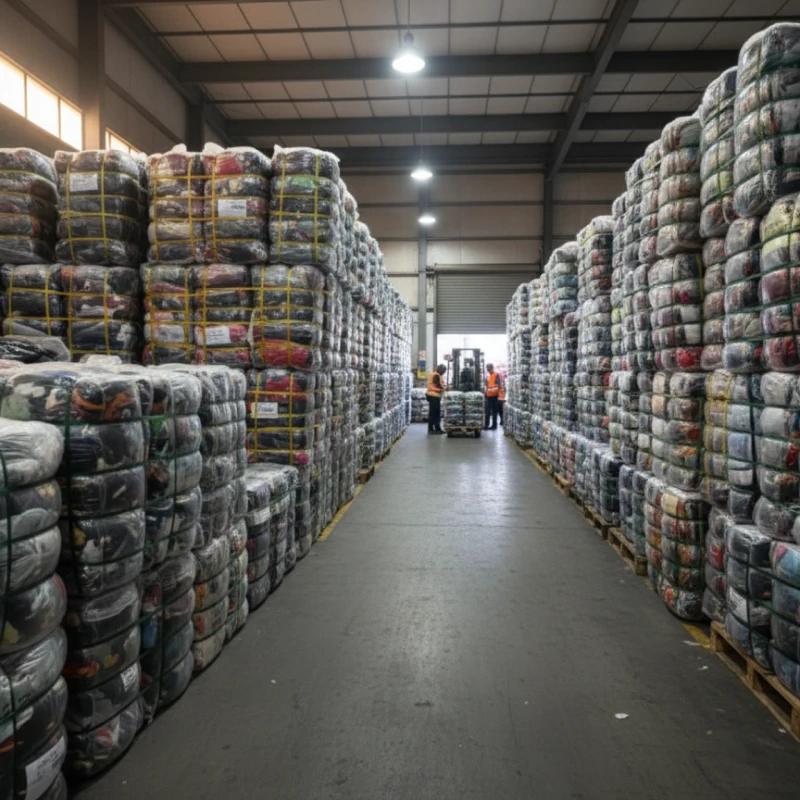
A real sorting facility image shows the product format; the current written order still defines what is being purchased.
Frequently Asked Questions
Where can I buy secondhand clothes in bulk in Johannesburg?
Start with local sealed-bale warehouses, category or pick-by-weight distributors, Gauteng specialists and nationwide-delivery wholesalers. Choose the route according to your inspection needs, test quantity and sales channel. Use the separate Johannesburg supplier list for current supplier names and verification notes.
Is a sealed bale better than clothing selected by weight?
Neither format is universally better. A sealed bale may be faster to collect and easier to handle as one unit, but the exact assortment is less visible. Pick-by-weight stock gives more control over individual condition and category, although selection time and heavier garments affect the unit cost.
Should a new reseller buy locally or import directly?
A new reseller should usually validate demand with legally available local or delivered stock. Overseas sourcing adds permit, customs, freight, receiving and working-capital requirements. It should be evaluated only after the buyer has sales records and written confirmation that the intended goods are eligible for import.
How can I compare two bulk clothing quotations?
Compare product status, category, grade exclusions, net garment weight, pack format, inspection evidence, claim terms, tax treatment and delivered cost. After a test, calculate cost per first-pass sellable item using your actual receiving results.
Can a supplier guarantee the number of garments in a clothing bale?
Weight alone cannot guarantee a fixed piece count because tops, denim and coats have different average weights. Ask whether the count was measured or estimated and which category the estimate represents. Treat an estimate as planning information unless it is written as a measured order field.
Is it legal to import used clothing into South Africa?
Used-clothing imports are tightly controlled, and ITAC generally does not grant permits except for narrowly defined purposes or categories. Confirm the exact goods, classification and intended use with ITAC and a qualified customs broker before ordering or paying an overseas supplier.
What should I send when requesting a wholesale quotation?
Send the destination, resale channel, category, season, defect exclusions, preferred pack format, test or commercial quantity, delivery requirement and evidence request. Ask the supplier to mark every unconfirmed field instead of filling gaps with assumptions.
Build the Next Purchase From Evidence
The most useful answer to where to buy secondhand clothes in bulk in Johannesburg is not one permanent seller name. It is a repeatable sourcing sequence: choose the correct route, verify the current offer, run a controlled test, record the receiving result and expand only when the stock fits your channel.
If you have confirmed a legally eligible destination and category and want to compare a commercial export specification, share the category, grade exclusions, bale weight, packing and order scale with Indetexx. Discuss the current requirement.
Discuss a Legally Eligible Bulk-Clothing Requirement
Share the destination, category, grade exclusions, bale weight, packing and order scale after confirming the applicable import route. Indetexx can identify which fields are available for the current quotation.