Ordering your first used clothing container of used clothing can either launch your business—or quietly drain your cash flow.
Most new buyers believe the biggest risk is overpaying. In reality, data from bulk resale operations shows the opposite: over 60% of first-container losses come from poor product mix and inconsistent grading—not price. Even more critical, a mismatched clothing mix can reduce resale efficiency and profit by 20–40% per container.
That’s why experienced used clothing importers don’t treat the first container as a simple purchase. They treat it as a controlled supply chain test—where every variable, from category ratio to bale weight, directly affects sell-through speed and cash recovery.
In this guide, you’ll learn how to reduce risk at every stage—from supplier selection to mix planning, quality verification, and shipment control—so your first container doesn’t just arrive, but sells fast, turns cash quickly, and sets up your second order with confidence.
Quick Takeaways
- Start with resale logic, not the cheapest quote.
- Grade consistency matters more than headline price.
- Wrong item ratios create dead stock fast.
- Remote inspection reduces surprises before loading.
- Test supplier transparency before scaling volume.
- Logistics timing affects cash flow and sell-through.
Why the first container order feels risky
A first used clothing container is different from a repeat order. You are not just buying goods. You are testing an entire supply chain.
More specifically, you are validating five operational systems simultaneously: sourcing quality, sorting accuracy, packing discipline, logistics reliability, and market fit. Failure in any one of these can affect the entire container’s performance.
That includes five linked questions:
- Can the supplier deliver the promised grade?
- Will the item mix fit your market?
- Is the bale weight and packing clear?
- Can the container ship on time?
- Will the margin still work after freight and local costs?
Many first-time buyers underestimate this chain. They compare suppliers using only price per kilo. That is a weak buying method because a cheaper container with poor grading or a bad seasonal mix often becomes more expensive after arrival.
Additional operational reality:
- A container with 10% excess unsellable items can erase 50–80% of expected profit
- A wrong seasonal mix (e.g., winter in hot markets) can delay turnover by 90–120 days
- Misaligned category ratios can increase sorting and handling costs by 15–25% locally
Indetexx’s buyer guidance highlights the same pattern. Common first-order mistakes include prioritizing price over consistency, ignoring factory scale, failing to verify grading standards, skipping test orders, and overlooking after-sales support.
That is why risk reduction should start with one principle: buy for sell-through, not for hope.
Define your market before you define your container
The safest first container is usually the one designed around one market, one customer type, and one turnover model.
Buyer persona guidance for bulk second-hand clothing trade shows that large importers, wholesalers, market traders, and online resellers do not buy for the same reasons. Large used clothing importers focus on stable supply and landed cost. Wholesale dealers care more about grade consistency and item ratios. Market traders prioritize fast-selling items and price-to-quality balance. Online resellers pay closer attention to brands, condition, and style trends.
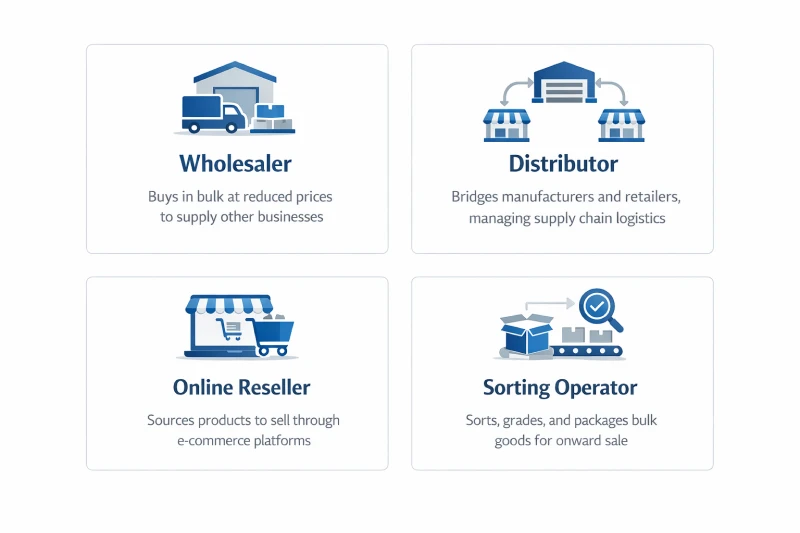
That creates very different “safe” first orders.
| Buyer type | Lower-risk first-container logic |
| Open-market wholesaler | Fast-selling basics, stable grades, simple mix |
| Mid-sized distributor | Clear category ratios, reliable packing, repeatable quality |
| Boutique or online reseller | Higher brand ratio, tighter QC, lower tolerance for defects |
| Sorting operator | Lower purchase cost, but only if in-house sorting is strong |
A new buyer in Africa, for example, may reduce risk with a summer-heavy mixed clothing container that focuses on turnover. A Latin American buyer may reduce risk better with cleaner, more fashionable branded stock. A Middle East buyer may need more attention to larger men’s sizes, modest styles, and better-condition shoes. Those regional patterns appear directly in Indetexx’s buyer persona materials.
Before you ask for a quote, answer these questions:
- Who will buy from you first?
- Which 10 categories sell fastest in your channel?
- Which items cause slow turnover?
- Do you need volume, margin, or proof of concept first?
If you cannot answer those questions clearly, your first container is still underplanned.
Choose consistency over the lowest price
The biggest first-order mistake is assuming the cheapest supplier is the safest used clothing supplier.
In used clothing, consistency is value. If one container lands with the right mix, clean grading, and saleable condition, it gives you pricing confidence. If the next arrives with more stains, wrong sizes, or too many slow movers, you lose margin and trust in your own channel.
That is why a stable grade matters so much. Indetexx’s brand materials outline a four-grade structure for used clothing—Cream, A, Brand, and B—with different market uses for each. They also emphasize fine sorting across 120 to 200 categories and sourcing from major Chinese cities to support more market-fit product mixes.
For first containers, safer usually means:
- Fewer category surprises
- Clearer grade definitions
- Better documentation
- Less sorting pressure after arrival
Here is the trade-off most new buyers face:
| Option | Lower upfront price? | Lower operational risk? | Better for first container? |
| Unsorted original clothing | Yes | No | Usually no |
| Mixed sorted clothing | Moderate | Yes | Usually yes |
| High-brand premium lots | No | Depends on market | Yes, if channel is proven |
Unsorted goods can look attractive because the cost per kilo is lower. But lower cost is not lower risk when you still need labor, space, quality control, and a local plan for low-grade leftovers. For most first-time importers, sorted stock is easier to price, easier to resell, and easier to evaluate after the container lands. That matches Indetexx’s own product logic, which frames mixed clothing as a lower-risk, faster-turnover choice for wholesalers, while original unsorted clothing fits buyers with their own sorting capacity.
Get the item mix right before the container is packed
A used clothing supplier can give you the correct grade and still deliver the wrong container.
This happens when the mix does not match your market. Too many coats in a hot market. Too many kids’ items in an adult-driven channel. Too many fashion-risk pieces and not enough bread-and-butter basics.
Indetexx’s recent article on clothing mix states that a poorly planned mix leads to slow-selling items, excess dead stock, and lower margins, while a well-designed mix can improve profit per container by 20 to 40 percent.
That is why the first order should be ratio-driven, not vague.
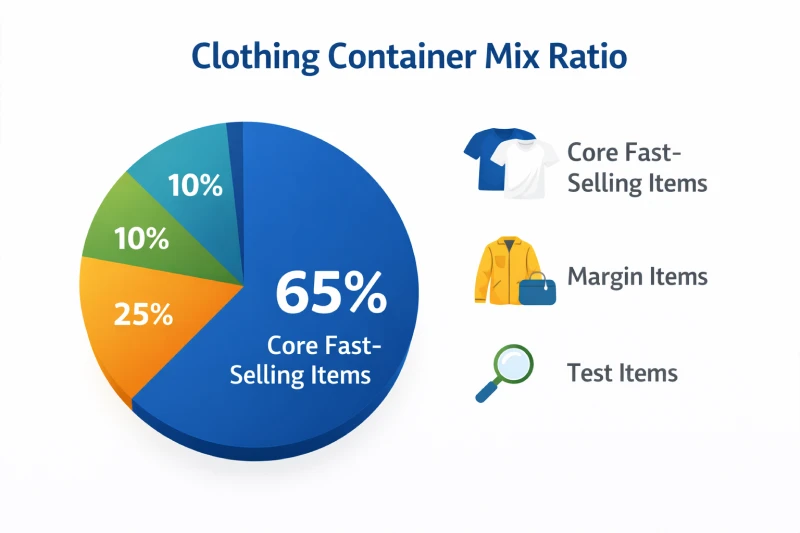
A practical first-container planning model looks like this:
Core layer: 60 to 70 percent proven fast sellers
These are your cash-flow items.
Examples may include:
- Men’s and women’s T-shirts
- Jeans
- Lightweight tops
- Casual shirts
- Entry-level shoes
Margin layer: 20 to 30 percent higher-value items
These raise average resale value without taking over the container.
Examples may include:
- Better-condition branded clothing
- Branded sports shoes
- Boutique bags
- Cleaner jackets
Test layer: 10 percent market-learning items
These help you learn without risking the whole container.
Examples may include:
- New size ranges
- A small branded capsule
- A different women’s category
- A trial shoe ratio
This framework works because it limits exposure. You still learn, but you do not gamble the whole container on assumptions.
Indetexx’s service materials also stress customizable category ratio, grade ratio, packing weight, and brand ratio for first-time planning. Their buyer guidance even frames “mixed + branded” combinations as a way to lower trial-and-error cost for new buyers.
Verify grading with evidence, not promises
In the second-hand trade, “Grade A” is not universal.
One used clothing supplier’s A can be another supplier’s B. That is why verbal assurance means very little. The safe move is to ask for proof in a structured way.
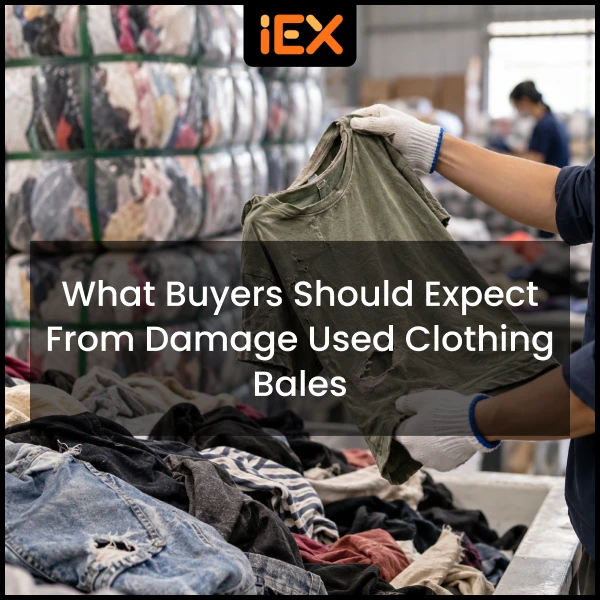
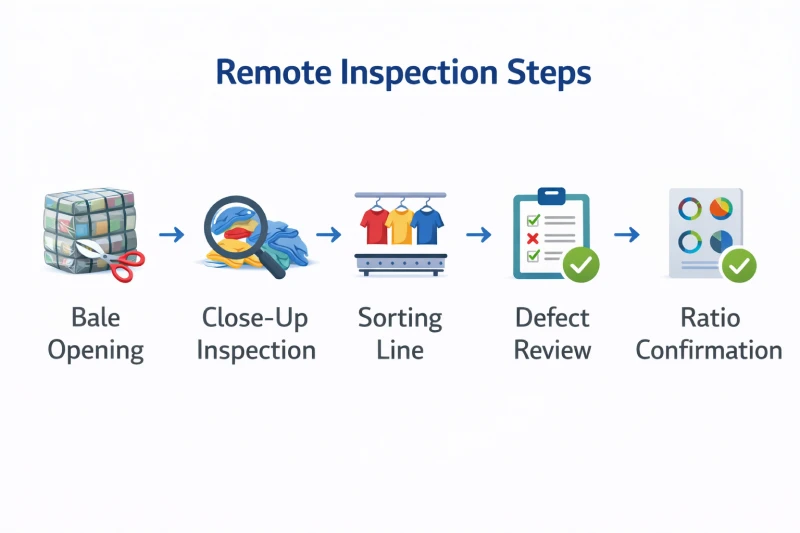
Indetexx’s own remote inspection article says experienced buyers do not rely on photos alone. They combine video inspections, bale-opening demonstrations, grading verification, and transparency checks before committing to a shipment.
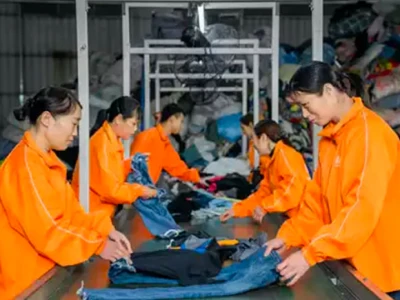
Ask for these before payment:
- Bale-opening videos
- Close-up condition videos
- Sorting line footage
- Grade definitions in writing
- Photos of common defects
- Packing photos by category
- Sample ratio explanation
Then compare that evidence against your market needs.
A useful first-order checklist is below:
| Verification point | What to ask | Why it reduces risk |
| Grade definition | Written explanation of each grade | Prevents vague quality claims |
| Bale opening | Live or recorded random opening | Shows real inside consistency |
| Defect tolerance | Ask what is excluded | Clarifies stain, tear, fade limits |
| Category ratio | Percentage by item group | Helps forecast resale speed |
| Packing standard | Weight per bale and bale count | Prevents shipment confusion |
| QC process | How many checks before loading | Reveals process maturity |
Indetexx’s strict quality control page says the company uses five rounds of inspection before delivery to support quality consistency.
That type of process matters because first-order risk often comes from inconsistency, not from one bad piece.
Control packing, bale weight, and loading details
New buyers often think risk ends once the product looks right.
It does not.
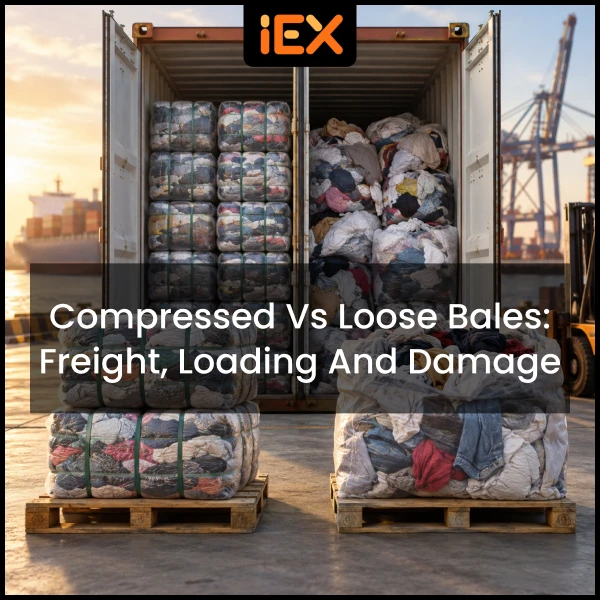
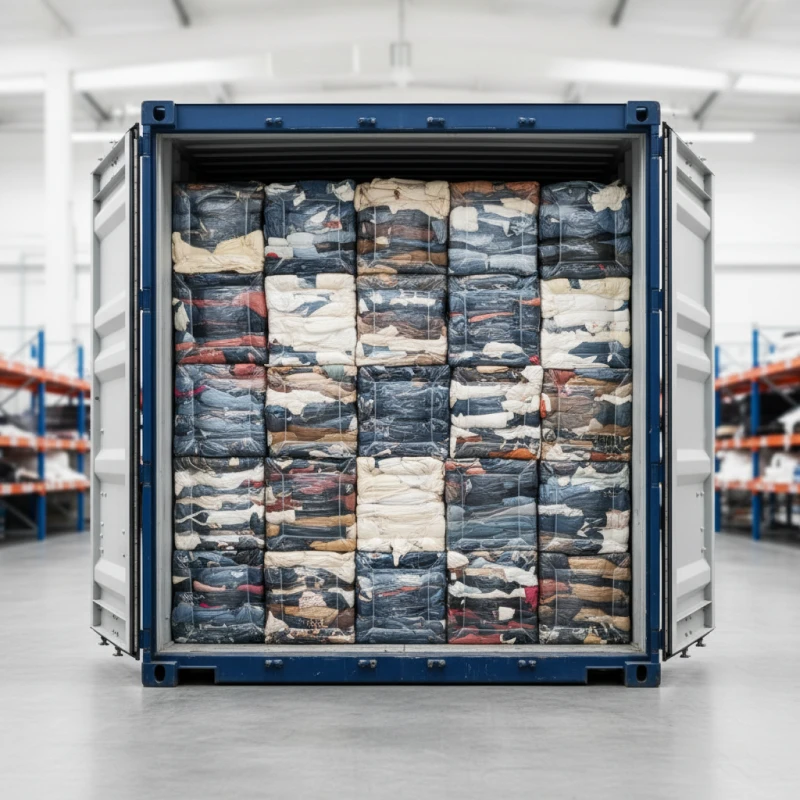
Packing discipline affects freight efficiency, warehouse handling, resale planning, and even disputes. If bale weight is unclear or inconsistent, your receiving process becomes harder. If the packing method is too loose, product condition can suffer. If the loading plan is poor, you may pay ocean freight on wasted space.
Indetexx’s customizing page lists example container configurations such as 45 kg, 85 kg, and 90 kg bale systems for 20-foot and 40-foot containers. Their service materials also emphasize flexible 40 to 100 kg bales, calibrated weighing, and high-compression packing to cut shipping costs.
For a first container, ask for these details in advance:
- Exact bale weight target
- Bale count estimate
- Packing list by category
- Net and gross weight
- Photos during loading
- Final container loading video
These details help you in three ways. First, they reduce misunderstandings. Second, they support customs and receiving checks. Third, they let you calculate unit economics more accurately.
A first-time importer should prefer clarity over aggressive compression claims. A “fuller” container is only good if the category mix remains what you ordered.
Reduce used clothing supplier risk with process questions
A supplier becomes safer when the process is visible.
That includes how they source, sort, inspect, customize, and ship. Indetexx’s materials position factory scale, stable raw material supply, sorting depth, and professional support as core risk-control advantages, including a 20,000㎡ factory, 6,000 tons monthly sorting capacity, 3,000 tons of regular raw material stock, and exports to 110+ countries.
Scale alone does not guarantee quality. But visible process usually lowers uncertainty.
Ask process questions like these:
- Where do your raw materials come from?
- How do you separate seasons and demographics?
- How do you handle stained or damaged goods?
- How many inspections happen before packing?
- Can you customize category and brand ratios?
- Who manages loading and shipping coordination?
The goal is not to interrogate. The goal is to see whether answers are operational or vague.
Operational answers sound like this:
- “We separate summer and winter before fine sorting.”
- “We do random bale checks before loading.”
- “We can adjust category ratios by market.”
- “We provide a packing list and loading record.”
Vague answers sound like this:
- “Don’t worry, quality is good.”
- “Everything is Grade A.”
- “We know your market.”
- “Just trust our experience.”
The first type reduces risk. The second increases it.
Protect cash flow by planning freight and timing early
Your first used clothing container can be profitable on paper and still fail on cash flow.
This usually happens when buyers ignore freight timing, port congestion, or local sell-through speed. A container that arrives late can miss a selling season. A container that arrives on time but with the wrong mix can trap capital in dead stock.
Indetexx’s delivering page says the company works with multiple freight forwarders to secure competitive shipping rates and aims for on-time shipment, including during peak seasons. Their how-to-order page also references standard order quantities such as one 40-foot container at 28,000 kg.
That means the safer first order is not always the biggest order you can afford. It is the order you can absorb, receive, and sell with control.
Use this timing logic:
| Decision point | Safer first-order approach |
| Seasonal demand | Buy one cycle ahead, not too early |
| Freight volatility | Ask for rate guidance before locking mix |
| Port handling | Confirm paperwork and receiving capacity |
| Working capital | Leave room for duties, inland transport, and sorting |
| Sales cycle | Match container size to realistic sell-through speed |
A first container should prove repeatability. It does not need to maximize volume on day one.
Build a Low-Risk First Container Plan
A practical first-order plan is not just steps—it’s a controlled execution checklist with measurable outputs. Below is a more specific version you can actually follow.
Step 1: Start with one clear market thesis
Define your container in one sentence with 3 variables:
👉 Customer + Product + Speed
Example:
“Open-market wholesalers in Ghana + women’s summer basics + fast turnover within 30 days.”
Checklist:
- Target buyer type (wholesale / retail / online)
- Climate (summer / winter / mixed)
- Target sell-through cycle (e.g., 30 / 60 days)
👉 If you cannot define this in one sentence, your order is too broad.
Step 2: Limit the mix to proven categories
Avoid over-diversification. First containers fail when buyers test too many ideas.
Recommended limit:
- 8–12 core categories ONLY
Example mix:
- T-shirts (25%)
- Jeans (20%)
- Shirts (15%)
- Lightweight tops (10%)
- Dresses (10%)
- Shoes (10%)
- Jackets (5%)
- Bags (5%)
Rule:
👉 No single category >30%
👉 No experimental category >10%
This keeps your inventory manageable and predictable.
Step 3: Ask for written grade and ratio confirmation
Turn verbal agreements into fixed reference documents.
Must-confirm items:
- Grade definition
- Example: “Grade A = no holes, no heavy stains, wearable condition”
- Example: “Grade A = no holes, no heavy stains, wearable condition”
- Category ratio
- Example: “T-shirts = 25% ±5%”
- Example: “T-shirts = 25% ±5%”
- Brand ratio (if applicable)
- Example: “Branded items = 15–20%”
- Example: “Branded items = 15–20%”
👉 Acceptable tolerance: ±5% only
Anything beyond that creates uncontrollable variation.
Step 4: Verify with video and random bale evidence
Do not rely on curated samples.
Minimum verification standard:
- 2–3 random bale opening videos (uncut)
- 1 continuous sorting line video (5–10 minutes)
- 10–20 close-up defect checks
What to look for:
- Consistency across bales (not just one good sample)
- Real defect rate (target: <5–8%)
- Category accuracy
👉 If supplier only sends “best samples,” risk is HIGH.
Step 5: Lock bale weights and packing format
Packing affects your cost per kg, warehouse handling, and resale flow.
Choose one standard:
- 45kg → easier handling, faster sorting
- 80–90kg → better freight efficiency
Confirm:
- Bale weight tolerance: ±2kg max
- Total bale count (e.g., 620–650 bales for 40HQ)
- Packing type (nylon / woven / compression)
👉 Inconsistent bale weight = inventory chaos.
Step 6: Confirm loading and freight timing
Timing mistakes can destroy profitability—even with good products.
Key confirmations:
- Production lead time (e.g., 7–15 days)
- Loading date
- Shipping ETD / ETA
- Transit time (e.g., 25–45 days)
Risk rule:
👉 If arrival misses peak season → profit can drop 20–30%
Also request:
- Container loading photos
- Container sealing video
- Bill of lading details
Step 7: Review results after landing (CRITICAL)
This is where most buyers fail—they do not measure performance.
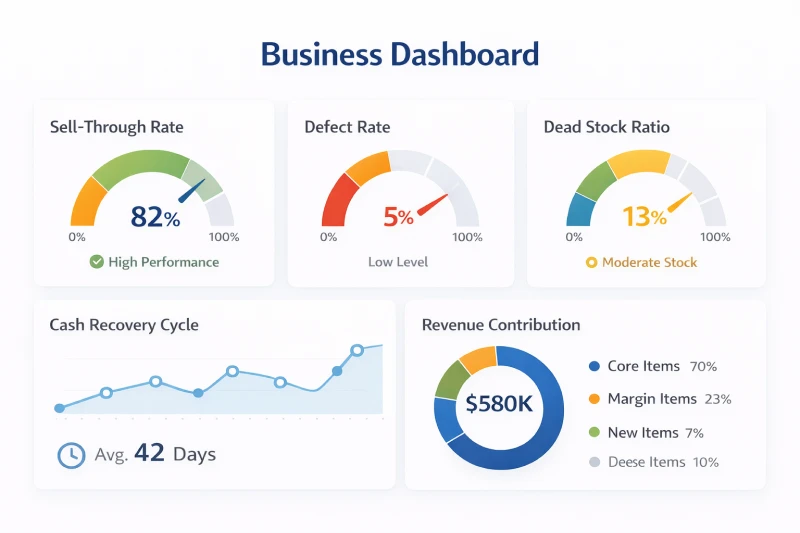
Track these 5 KPIs:
| KPI | Target |
| Sell-through (30 days) | 50–70% |
| Defect rate | <5–8% |
| Top 5 category contribution | >60% revenue |
| Dead stock ratio | <20% |
| Cash recovery cycle | <60 days |
Example insight after first container:
- T-shirts sold out in 2 weeks → increase to 30%
- Jackets slow → reduce to 2–3%
- Shoes high margin → increase selectively
👉 This is how you turn your first container into a data-driven second order
FAQ: First Container Order (6 Specific Questions)
What is the safest first container size?
Start with 1×40HQ only if you can sell 60% within 30–45 days.
If not, simplify the mix instead of reducing volume.
Should I choose sorted or unsorted clothing?
Choose Grade A mixed sorted clothing (100–120 categories).
Avoid original unsorted unless you have sorting staff + warehouse + waste plan.
How exactly do I verify quality remotely?
Request 3 proofs before payment:
- 2–3 random bale opening videos (uncut)
- Close-up defect check (stains, tears, fading)
- Sorting line footage (5–10 minutes continuous)
What is a safe first-container mix ratio?
Use this structure:
- 65% basics (T-shirts, jeans, shirts)
- 25% higher-value (branded, jackets, better shoes)
- 10% test items (new categories or sizes)
How do I avoid receiving the wrong goods?
Confirm in writing before loading:
- Category ratio (e.g., 30% T-shirts)
- Grade definition (what is excluded)
- Bale weight (e.g., 45kg or 90kg)
Then request loading photos + container sealing video.
How do I control financial risk on the first order?
Plan for full landed cost:
- Product + freight + duty + inland transport
Keep 20–30% cash buffer and prioritize fast-turn items over high-risk fashion pieces.
Conclusion
Reducing risk in your first container order is not about eliminating uncertainty completely. It is about replacing guesswork with evidence. When you define your market clearly, choose consistency over headline price, control the item mix, verify grading with proof, and plan packing and freight early, your first order becomes a measured business decision instead of a gamble.
For B2B buyers, that is the real goal. A first used clothing container should teach you what scales, protect your cash flow, and create a repeatable sourcing model. Indetexx’s buyer and brand materials consistently frame that model around stable supply, fine sorting, customization, quality control, and logistics support for international buyers.
Ready to Source Your First Shoe Container?
Indetexx ships Grade A and Grade B used shoe bales to 110+ countries with Recydoc-lot-tracked grading. Every bale ships with documented composition reports, pre-shipment photos, and size distribution data so you can verify grade accuracy before the container sails.
Our 20,000㎡ sorting factory processes 6,000 tons of footwear monthly, ensuring consistent supply for buyers across Africa, Southeast Asia, and Latin America.