Buying a mixed return pallet is a different decision from buying a single-category lot. You are not judging one product group; you are pricing a composition. How much of the load is consumer electronics, how much is kitchenware, homeware or apparel, what condition band each group sits in, and how much of it your own market will absorb. The load can still work, but only when the mix is specified before the price is agreed.
This guide is written for importers and wholesalers who buy mixed return goods at pallet level and consolidate them into container volume. It covers what a mixed pallet actually contains, what a manifest does and does not prove, how these lots are priced, how recovery and processing costs decide your margin, and what belongs in writing before you pay a deposit.
Quick Takeaways
- The composition is the product. Agree the category groups and their shares before you compare prices, because a pallet count tells you nothing about the mix.
- A manifest is a description of what the seller listed, not a guarantee of what arrives. Unmanifested loads move more of that risk onto you.
- Mixed lots are priced by auction outcome, by weight or by container specification. No supplier has a published discount to retail for a mixed load.
- Recovery is only half the economics. Add labour, testing, cleaning, storage, freight and disposal before you judge whether a quote is cheap.
- Pallet-level buying and container-level buying fail for different reasons; know which model your cash flow can survive.
What a Mixed Return Pallet Actually Contains
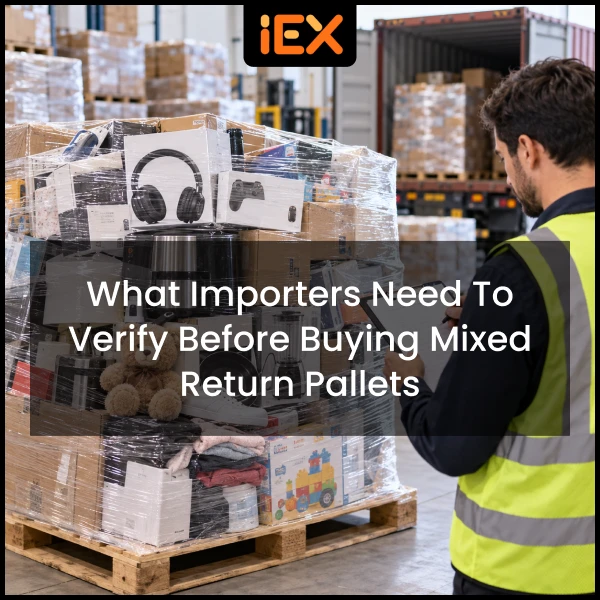
A mixed return pallet is assembled from more than one product group. The usual groups are consumer electronics and accessories, small appliances and kitchenware, homeware, toys, apparel, and general merchandise. That list is not a specification, and the industry vocabulary does not help much either: some sellers say mixed merchandise, some say assorted lots, some say general merchandise, and the same words describe very different loads.

What matters commercially is how the mix was created, because the method predicts whether you can repeat it on the next order.
How a Return Load Ends Up Mixed
A lot mixed by design is assembled to a stated share: for example six parts electronics, three parts kitchenware, one part toys, packed and marked by group. The next order can be built the same way, so your resale plan stays stable and your quotations become comparable.
A lot mixed by leftover is whatever remained after the category-sorted lots were sold. It is not dishonest, and it can be the cheapest way into a market that sells everything. It is also unpredictable: the second order will not match the first, which makes pricing, staffing and reordering guesswork. If a supplier cannot tell you which of the two you are being offered, treat the answer as the first useful test of the relationship.
What Sets the Category Mix
Three things decide the composition, and all three are outside your control unless you specify them. Return behaviour comes first: apparel and consumer electronics are returned more often than heavy or low-value goods, which is why mixed loads skew toward those groups. The seller’s sorting step comes second, because a load sold before sorting carries whatever the collection contained. What other buyers took comes third, since the highest-value units are usually pulled out first.
The practical consequence is a destination question rather than a sourcing question. A load that is heavy in apparel suits a market with strong clothing demand and cheap local sorting labour. A load that is heavy in small electronics suits a market with repair capacity and a resale channel for tested devices. Ask for the approximate group shares and match them to the buyers you already have.
Manifested vs Unmanifested: What the List Actually Proves
A manifest is an inventory list. On a manifested lot it is often available before the auction closes and records units, quantities or retail values. An unmanifested lot has none of that, and is sold on a described category, weight or pallet count instead.
The useful distinction is not which lot is better; it is how much of the risk you can measure before bidding. A manifest moves some of the unknown into a document you can price. It does not move all of it, because a manifest records what the seller listed and says nothing about whether every unit is present, complete or working.
Electronics is where this bites hardest. A manifest value is usually a retail figure, and retail value says nothing about whether a device powers on, whether the accessories came back with it, or whether the battery has any life left. Experienced buyers discount manifest value by category rather than trusting the total. Before you commit, ask what happens when the delivered load disagrees with the list, and get the answer in writing. On a container order, the durable protection is a specification you agreed plus a receiving check you can run yourself.
How Mixed Lots Are Priced
There is no published mixed-lot price list, and any supplier quoting a fixed percentage off retail is describing a marketing position rather than a market. Pricing runs on three different bases, and comparing across them is the most common way importers misjudge a deal.
Per Pallet, Per Kilo and Per Container
- Per pallet: the price is set where the auction closes, so it reflects who else wanted that lot on that day, not what the load is worth to you.
- Per kilo or per pound: common on textile and mixed-carton supply. It is easy to compare and it hides composition, because two loads at the same weight can differ completely in what they contain.
- Per container: priced against the specified mix, packing and destination. This is the only basis where the composition is part of the price instead of an assumption.
Why Two Quotes for the Same Mix Differ
Two suppliers quoting the same group shares can still land far apart, and the gap is usually explained by five things: where each lot came from in the supply stream, the assumed condition band inside each group, the labour and packing included, whether freight and handling are inside the number, and what documentation comes with the load. None of those differences show up in a headline price per pallet.
That is why the comparison has to happen on a written basis. Ask each supplier to quote the same category groups, the same ratio basis, the same packing format and the same destination terms. When a quote cannot be reduced to that structure, you are not comparing offers; you are comparing descriptions.
Want the Mix Priced on the Same Basis Across Suppliers?
Send the category groups, the share you want for each, the ratio basis, the packing format and your destination. Indetexx quotes a mixed order against the specification you actually plan to buy, so two offers can be compared line by line instead of by headline price.
Send Your Mix RequirementsRecovery, Processing and Landed Cost
Buyers in this trade quote recovery ranges rather than a single number: roughly 20 to 40 percent of the load working out as sellable on difficult loads, 40 to 60 percent on average loads, and 60 percent or more on strong inventory. Those are trade estimates rather than published standards, and they move with category, condition and the channel you sell through. Treat any figure as a planning assumption that your own receiving data has to confirm.

Recovery is only the first half of the calculation. Every mixed load also carries processing cost: labour to sort and count, testing for anything electrical, cleaning and repacking, storage while you sell through, and disposal for the share that cannot be resold at all. On a mixed load, disposal is a real line item rather than an afterthought, because the mix guarantees that some categories will clear faster than others.
Landed cost is the third half, and importers who buy pallets one at a time tend to discover it late. Freight, terminal handling, duty, customs clearance, inland transport and the cost of money while the container clears all sit on top of the load price. Comparing that structure against the site’s pallet-by-pallet versus container-scale review is worth doing before you scale up, because the model that looks cheaper per pallet is often the more expensive one per sellable unit.
Consolidating Mixed Lots Into a Container
Consolidation is where mixed sourcing starts to make sense for importers. Instead of accepting whichever pallets are available and discovering the mix at the destination port, you decide the group shares first, then buy or assemble loads that fill them.
The mechanics are straightforward but unforgiving. Decide the group shares, then the packing unit for each group, then the loading plan. Pallet counts rarely divide evenly into container capacity, so volume, weight and stack height have to be reconciled together; a load that fits by pallet count can still fail on weight. Marking matters as much as loading, because a mixed container that arrives unmarked adds days to the receiving sort.
This is also where a supplier has to be specific rather than reassuring. Indetexx builds mixed orders from stated category groups, ratio basis and packing, and ships on 20ft or 40ft container plans. Ask for the loading plan with the quotation, along with the group shares it is meant to carry. The loading plan proves how the space and weight are allocated; it does not certify the condition mix inside the units, and no supplier should describe it that way.
What to Verify Before You Pay
The Specification to Ask For
A mixed order is only as good as what is written down. Before a deposit moves, the following belong in the order documents rather than in a chat thread:
- The category groups in the load and the share of each, stated as a percentage or a ratio
- The ratio basis: by unit, by weight or by pallet, because the same share means different things on each basis
- The packing and marking convention, including how groups are separated inside the container
- What is excluded, such as hazardous goods, liquids or restricted electronics
- How unsellable or damaged units are treated, and who carries that cost
- Which documents and photographs you will receive, and when, relative to payment and loading
A supplier who quotes a specific mix against that structure is answering your question. Indetexx quotes mixed orders on exactly that basis, which is what makes two offers genuinely comparable; what it does not do is convert the specification into a promise that every unit inside the mix will be sellable in your market.
Sampling, Photos and Their Limits
Sampling should cross categories, not repeat one pallet. Two or three cartons from each group tell you more about a mixed load than a full inspection of the group you already trust, and the sample should be drawn after the load is assembled rather than while it is still being built.
Photographs are evidence of what was photographed. They are useful for confirming that the groups, packing and marking match the specification, and they are weak at confirming the contents of sealed units. That boundary matters most with electronics, where the question is usually function rather than appearance. If you need condition verified before payment, agree who verifies it, at which point in the process, and what the record of that check will look like.
Frequently Asked Questions
What is usually inside a mixed return pallet?
A mixed return pallet pulls from more than one product group, most often consumer electronics, small appliances, kitchenware, toys, apparel and accessories, and general merchandise. The word mixed says nothing about the share of each group, which is why the composition has to be written down rather than assumed from the pallet count.
Are mixed return pallets worth buying?
They can be, for the right buyer. Mixed loads suit importers whose market absorbs several categories and who can sort locally. They are a poor fit when your business depends on one product group, because a load heavy in unsellable categories turns into storage and disposal cost rather than margin.
Where can importers find mixed electronics pallets for sale?
Mixed electronics lots move through liquidation marketplaces, wholesale suppliers and exporters rather than through Amazon directly. Amazon runs no public pallet shop; returns and surplus are cleared through auction marketplaces. Importers usually end up comparing auction lots with supplier-held stock, and the deciding factor is the same in both cases: how precisely the electronics share is specified.
How much does a mixed return pallet cost?
Pallet pricing is set where the auction closes, so there is no published rate. As a planning reference, small mixed pallets in the United States commonly trade in the low hundreds of dollars and large or electronics-heavy loads run into the thousands. Treat any figure you are given as a price for that specific lot on that specific day, not a market rate.
Can I combine categories in one container?
Yes, and for importers it is usually the point. Consolidating mixed lots into one container lets you build the group shares you can actually sell instead of accepting whichever loads happen to be available. It changes the loading and freight maths, not the condition mix, so the specification still has to be agreed before loading.
Is a manifest a guarantee of what I will receive?
No. A manifest records what the seller listed. It does not promise that every unit is present, complete or working, and it does not cover condition. Use it to price how much risk you can measure before you commit, and pair it with a written specification and a receiving check of your own.
Next Step: Confirm the Mix Before You Compare Prices
A mixed return load is a composition decision, and it stays cheap only while the composition stays specified. Decide which groups your market can absorb, put a share against each one, agree the packing and exclusions in writing, and then compare suppliers on that basis. Importers who do this stop being surprised by what arrives, and they get quotations that can actually be compared.
If you are weighing a pallet trial against a consolidated container, this site’s guide to buying Amazon return pallets explains the sourcing side, and the Amazon and Temu return pallet range shows how mixed returns are grouped for export. Sourcing electronics only is a different risk profile, covered in the electronics stocklots guide.
Ready to Build a Mixed Load You Can Actually Sell?
Indetexx supplies Amazon return pallets, electronics stocklots and mixed stock lots for importers. Tell us the categories, the shares, the packing and the destination port, and we will come back with the current written order details for that mix.
A quotation describes the order you specify; it is not a promise about the condition mix, yield or resale outcome of any particular shipment.
Request Current Mixed Lot Details