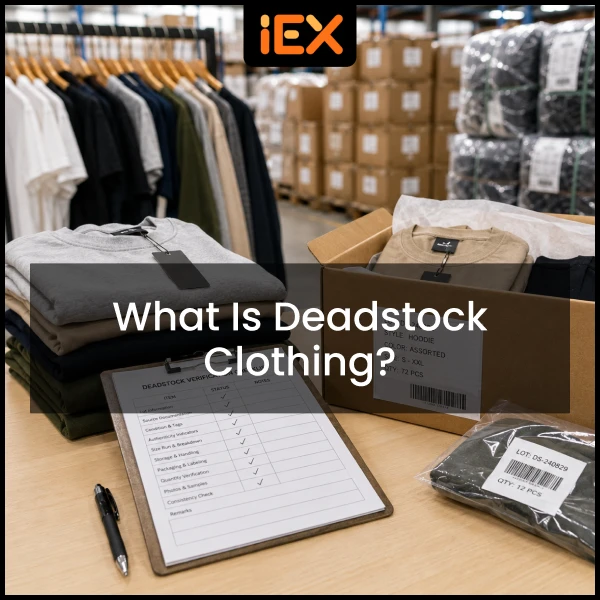
Deadstock clothing has no single universal wholesale definition. In inventory management, it can mean merchandise that has stopped selling. In vintage, streetwear, and resale markets, it can mean older stock claimed to be unused or unworn. In textile sourcing, “deadstock” may refer to leftover fabric rather than finished garments.
That ambiguity changes how you should buy. The label alone does not prove condition, original tags, authenticity, brand authorization, a complete size run, or repeat supply. Treat “deadstock” as a seller claim that must be translated into current-lot facts before you pay or book freight.
This guide gives you a narrow verification method. It does not replace destination-country advice on trademark rights, labeling, customs classification, or importability.
What “Deadstock Clothing” Can Mean in a Wholesale Offer
The first question is not “Is deadstock good?” It is “Which meaning are we using for this lot?” Shopify’s inventory explanation notes that retailers generally use dead stock for inventory that no longer sells, while some sneaker and resale markets use the term for brand-new, unworn goods. Textile sourcing adds a third meaning.
The Textile Exchange circularity guide uses overstock and deadstock within pre-consumer material discussions and notes that the last metres of fabric rolls may be called deadstock material. If a quotation is for finished clothing, do not let evidence about unused fabric stand in for evidence about the garments.
Deadstock can overlap with overstock, liquidation, surplus, clearance, or vintage language, but those words describe different aspects of a commercial offer. Use the guide to used clothing, liquidation, and overstock for that broader product-state comparison. Here, the task is smaller: decide whether the claimed deadstock status is supported for one current lot.

Turn the Deadstock Label Into a Testable Lot Claim
Ask the seller to replace the single word with a full sentence. For example:
“This offer is a finite lot of finished garments from an earlier selling cycle, represented as new and unworn, stored since the stated period, and identified by the attached lot sheet.”
That sentence is not proof. It simply creates facts that can be checked. Give each material fact one of three statuses:
- Supported: the evidence relates to the offered lot and agrees with the other records.
- Contradictory: two or more current records disagree, or the evidence conflicts with the claim.
- Unverified: the seller has not provided enough lot-linked evidence to reach either conclusion.
Use a claim-to-evidence matrix before turning the wording into a purchase specification.
One document should not be forced to prove every row. A commercial invoice can identify the parties and goods, but it does not by itself prove unworn condition. Tags may support a product-state claim, but they do not automatically prove authenticity, authorization, or a complete size run.
Evidence also has different strength. A practical order is:
- listing text or a sales message;
- generic catalogue or warehouse photographs;
- current-lot photographs or a continuous video tied to a lot reference;
- a current lot sheet plus source, style, size, and quantity records; and
- a reconciled sample or inspection whose findings match the lot sheet and commercial description.
The last step still does not guarantee a defect-free shipment. It gives you a better basis for recording what was checked, what was not checked, and which exceptions the parties accepted.
Trace the Lot From the Surplus Event to the Current Seller
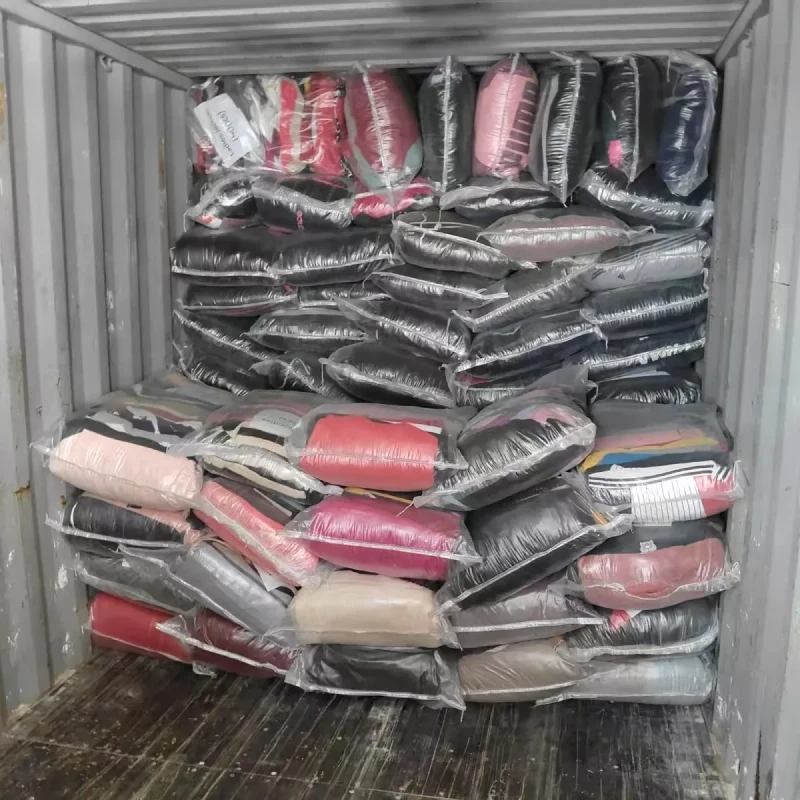
Deadstock-specific provenance starts with the event that produced the goods. It might be an unsold retail cycle, a discontinued style, a cancelled order, or another surplus event. Ask the seller to state the event precisely rather than choosing the most attractive explanation after the fact.
Then connect four points:
surplus event → source or ownership record → current seller → current lot ID
The records do not all need the same format, and legitimate commercial details may be redacted. They do need to tell a coherent story about the offered goods. A source record for one style does not support an unrelated mixed lot. A photograph taken in the seller’s facility does not establish how the seller acquired the goods. A lot ID written after the request is useful only if the same reference follows the current media, lot sheet, quotation, and inspection.
This is intentionally narrower than a full supplier audit. If you need sourcing channels, landed-cost checks, or a general buying brief, use the guide to apparel stock clearance suppliers. Before sending money, also verify the wholesale clothing supplier before payment as a separate company and transaction check.
Indetexx may discuss selected Chinese-brand stock when suitable current inventory is available. For any such inquiry, ask us to connect the current offer to a lot ID, product state, styles or SKUs, size information, quantity, packing, and available source records. Availability of a lot does not mean Indetexx is an official brand representative, and it does not promise authorization, a complete size run, or future replenishment.
Build a Current-Lot Evidence Pack Before Payment
Do not collect files without a matching rule. Give the offered lot one reference and require that reference—or another clearly reconcilable identifier—across the quotation, lot matrix, current media, sample record, invoice, and packing plan. A useful pre-payment pack contains:
- the seller’s legal name, business address, quotation entity, invoice entity, and bank beneficiary;
- the lot ID, storage location, inspection date, and the date the offer remains valid;
- the source or ownership record available for the styles in the current lot;
- a style/SKU–color–size–quantity matrix, with unknown fields marked as unknown;
- randomly selected current-lot photos or continuous video, including labels, packaging, several cartons, and visible exceptions;
- the agreed product state, condition exceptions, tag coverage, substitutions, and sample-selection method;
- any authenticity or authorization statement written narrowly enough to identify its evidence, products, territory, and scope; and
- the accepted claim window and the records required if the received shipment differs from the specification.
The pack is a reconciliation tool, not a guarantee. A redacted source record may still be useful if the remaining information connects it to the offered styles and seller. A polished certificate that cannot be tied to the lot is weaker than ordinary records that agree with the physical sample and shipment file.
Treat payment details as their own control. The seller, invoice issuer, and bank beneficiary may differ for legitimate reasons, but the relationship should be documented and independently confirmed before payment. The FBI’s business email compromise guidance specifically advises verifying payment requests and changes through a known contact method. If bank instructions change, stop and call a previously verified number or contact—not the new details inside the change message.
Verify Unworn Condition After Storage and Handling
“Unworn” answers only one condition question. It does not mean pristine. The Vintage Fashion Guild’s deadstock reference notes that unused vintage goods can still show problems caused by long storage, including fading, stains, odor, holes, or corrosion.
Adjust the condition review to the product and storage history. Useful checks may include:
- color change at shoulders, folds, windowside surfaces, or exposed package edges;
- mildew or persistent storage odor;
- dust, water marks, oil transfer, or carton staining;
- brittle elastic, degraded foam, peeling coatings, or adhesive failure;
- corrosion or discoloration on zippers, snaps, buckles, or other hardware;
- insect damage or small holes hidden at seams and folds;
- missing, detached, replaced, or inconsistent tags and packaging; and
- mixed returns, display pieces, samples, or used items inside a supposedly uniform lot.
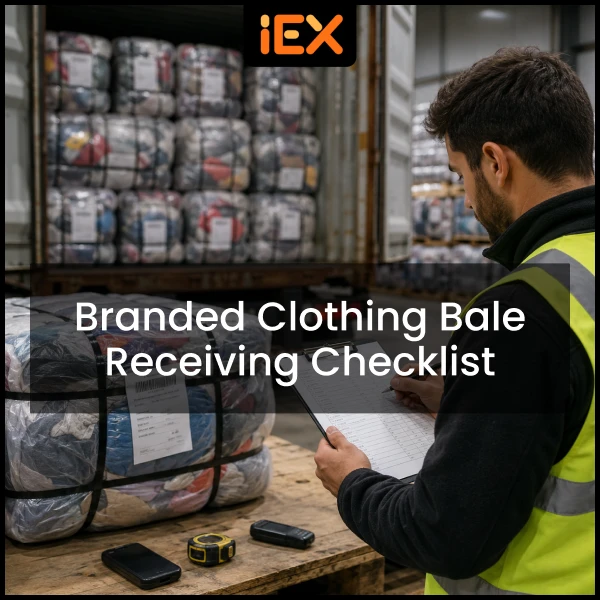
Request current-lot views that make these risks visible. A rack photograph can show category and color but may not show cuffs, underarms, labels, hardware, packaging, or the bottom cartons. A sample can reveal real defects but may still be unrepresentative. Record the sample-selection method, inspected quantity, findings, exceptions, and whether the seller may substitute stock before packing.
If the seller represents the full lot as unworn and your sample contains worn pieces, do not average the contradiction away. Change the lot definition, agree a measurable exclusion and reinspection method, or stop the purchase.

Verify Labels and Product Identifiers on Random Units
Labels are useful when they are treated as fields to reconcile, not as a single authenticity test. For U.S. sales, the FTC textile-label guide explains that most covered textile products must disclose fiber content, country of origin, and the identity of the responsible manufacturer, importer, or dealer; clothing also has care-label requirements. Other destinations have their own rules, so use the U.S. example as a checklist prompt rather than a universal labeling standard.
Ask the seller to choose units randomly from different cartons and show, where present:
- the brand and style labels;
- the permanent fiber-content and country-of-origin label;
- the care label;
- the RN or company identity shown on the label;
- the GTIN, UPC, or EAN and the seller’s SKU;
- size and color codes; and
- the carton number and current lot reference.
For an RN, use the FTC RN Database to check the business identity associated with the number. For a GTIN, Verified by GS1 can return the company and any available basic product data associated with the identifier. Compare those results with the seller’s lot matrix, source record, product, and packaging.
An RN or GTIN match is only an identity cross-check. It does not authenticate the physical garment, prove ownership of the lot, confirm an authorized sales channel, or grant destination-market resale rights. Inconsistent identifiers are a reason to investigate; consistent identifiers are one supporting layer, not a final conclusion.
Reconcile the Current Lot Without Assuming a Full Size Run
Deadstock is often finite. That makes the current matrix more important, not less. Reconcile the lot at the level needed for your resale model:
- lot ID and physical location;
- finished garment, fabric, footwear, accessory, or mixed-product status;
- style or SKU, category, color, and season where available;
- size labels and quantity by size;
- total units and the basis of the count;
- tag and packaging status;
- condition exceptions; and
- carton, bale, hanging, pallet, or other packing plan.
Mark every field as confirmed, representative, or unavailable. “Representative” means the information helps describe the offer but has not been reconciled to every item. “Unavailable” may be commercially acceptable for some mixed lots, but it cannot be promoted as a confirmed complete assortment.
Compare the matrix total with the quotation quantity and packing plan. If 4,000 units are offered but the style-size sheet totals 3,500, the remaining 500 units need a separate status. If the offer is sold by weight rather than pieces, record what the weight includes and avoid presenting a precise unit matrix that was only estimated.
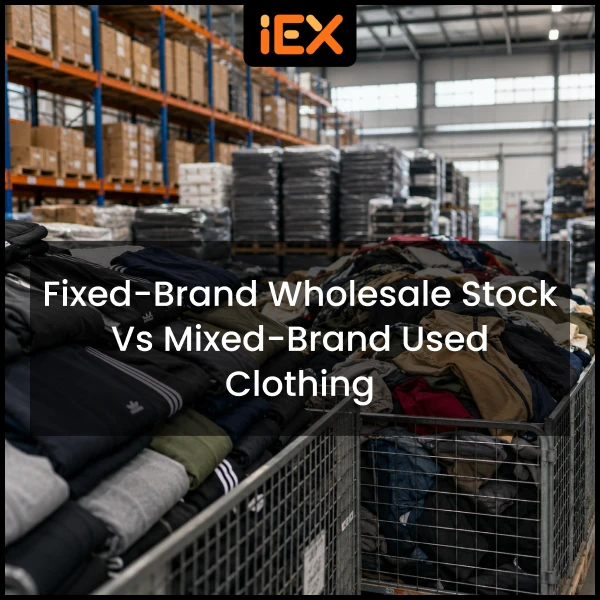
Do not turn deadstock into a replenishment promise. If your stores depend on repeated styles or all sizes, ask whether the seller is offering one finite lot, periodic surplus opportunities, or a contractual recurring program. Those are different commercial propositions. Use the separate comparison of fixed-brand wholesale stock vs mixed-brand used clothing when the real decision is assortment consistency versus broader category supply.
Compare offers on accepted sellable units, not only offered units. Use:
landed cost per accepted sellable unit = total landed cost ÷ accepted sellable units
For illustration only, if a 1,000-unit lot has a total landed cost of $6,000 and your documented receiving review accepts 920 units under your own specification, the arithmetic is $6.00 per offered unit but approximately $6.52 per accepted sellable unit. Those figures are not an Indetexx quotation, promised defect rate, expected yield, or profit forecast. Before delivery, use conservative scenarios; after delivery, replace assumptions with your actual receiving record.
Check Brand, Label, and Resale Claims Separately
A lot can be genuine without the seller being an authorized distributor. A seller can own goods without having permission to use a brand’s marketing assets. Goods that may be resold in one market may face different trademark, labeling, or parallel-import treatment in another.
WIPO’s trademark guide explains that countries use different approaches to exhaustion of trademark rights and parallel imports. That is why a wholesale buyer should not compress four questions into one:
- Source and ownership: how did the current seller obtain the lot, and can it lawfully transfer the goods?
- Authenticity: what supports the identity of the actual items in this lot?
- Claimed authorization: is any brand approval or channel authorization actually claimed, and what document defines its products, territory, and scope?
- Destination use: may you import, advertise, relabel, and resell the goods as planned under the destination rules?
Ask for evidence only as broadly as the seller’s claim requires. If the seller makes no authorization claim, do not convert silence into approval. If it does make the claim, require a lot-relevant document and verify it through an appropriate channel. When destination rights are material or unclear, pause and obtain local legal or customs advice before payment.
Reconcile the Quote, Lot Matrix, Sample, Invoice, and Packing List
Deadstock clothing may be useful in a sales conversation, but it can be too vague as the only goods description. The accepted specification, quotation, commercial invoice, packing list, and shipping instructions should communicate the actual product state: new or used, finished garments or material, categories, construction or material where required, quantities, values, origin, and packing.
The U.S. International Trade Administration’s document guide explains that a packing list itemizes package and goods facts and does not replace the commercial invoice. The exact destination rules vary, but one broadly useful control is to compare the same fields across the commercial and physical records.
Resolve discrepancies before the shipment file is finalized. Do not repair the paperwork by changing every document to match an unsupported sales claim. The goal is for the records to describe the actual accepted goods consistently.
For example, a commercial line might describe “new, unworn finished garments from a prior selling cycle” and then separate categories, materials or styles as the destination broker requires. Do not use that example as a ready-made customs description; the actual product and jurisdiction determine the necessary detail.
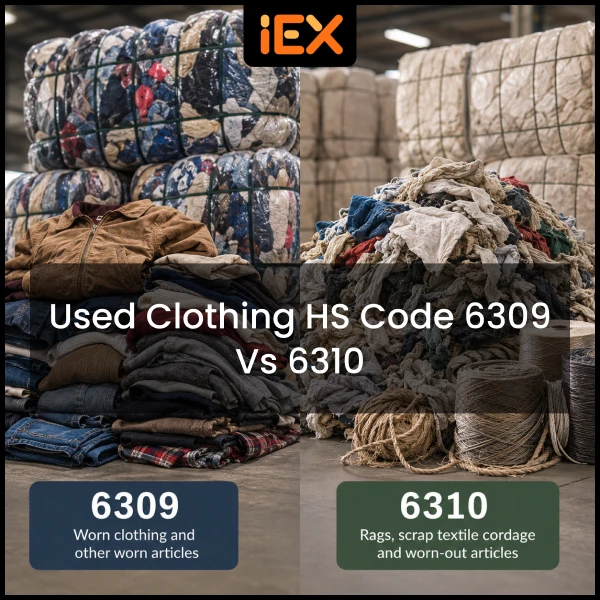
For U.S. imports, new or unworn stock does not become heading 6309 merchandise merely because it is old, unsold, called deadstock, or packed in bales. Chapter 63 Note 3 requires appreciable wear as well as specified packing conditions. Use the detailed used clothing HS code 6309 vs 6310 guide to organize the product facts, then ask the destination-country broker to review the live goods or consider an advance or binding ruling when the uncertainty is material.
Use a GO / CLARIFY / STOP Decision Before Payment
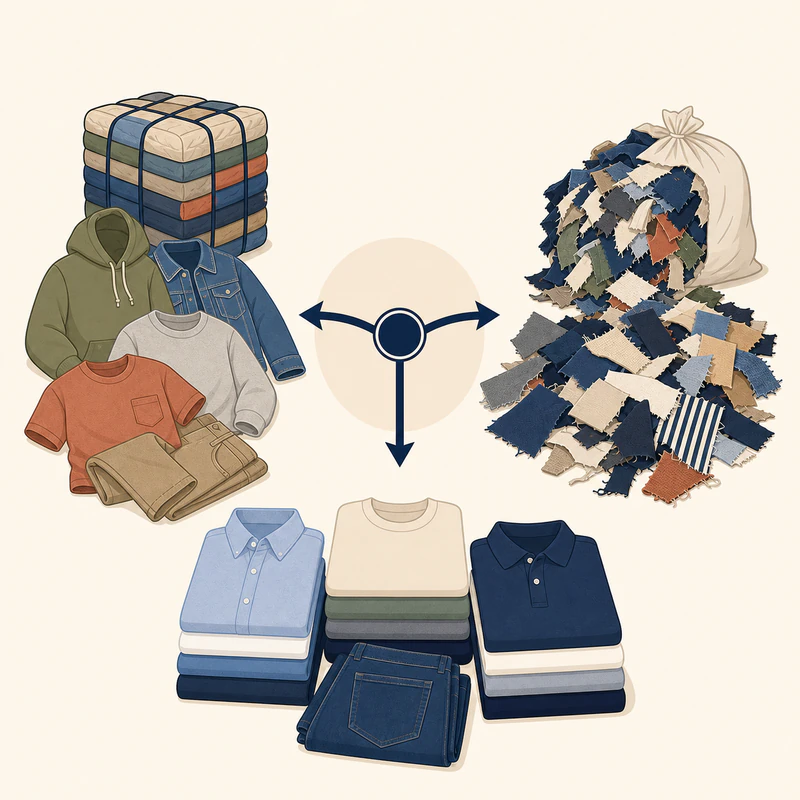
Finish with a decision about the evidence, not an impression of the seller’s vocabulary.
Examples of CLARIFY include a missing size total, unclear tag coverage, or current media that cannot be tied to the lot sheet. Examples of STOP include used garments inside a lot represented as uniformly unworn, an authorization claim that the named rights holder does not support, a quote and packing list that describe materially different goods, or changed bank instructions that cannot be independently verified through the previously known contact route.
If the actual offer is second-hand clothing, it should be quoted as used clothing with the current category, condition/grade, packing, quantity, and exclusions—not renamed deadstock. Define that alternative with a used clothing bale specification sheet and review current wholesale used clothing options separately. Those commercial details do not guarantee sellable yield, brand ratio, product composition, or destination customs treatment.
The final question is simple: can another reviewer connect the claim, lot, evidence, specification, and shipment file without guessing? If not, the lot is still unverified.
Frequently Asked Questions
Is deadstock clothing new or used?
It depends on the seller’s usage. Inventory teams may call any non-selling inventory dead stock, while resale markets often use deadstock for older merchandise claimed to be unused or unworn. Ask the seller to state the exact product condition for the current lot and support it with lot-linked evidence.
Which documents should a deadstock clothing buyer request?
Request a current quotation or purchase order, lot-linked source or ownership record, SKU–color–size–quantity matrix, current media or sample record, condition and substitution terms, commercial invoice, packing list, and the payment-beneficiary details. The exact legal and customs documents depend on the goods, route, and destination.
Does an RN, GTIN, or original tag prove authenticity?
No. An RN or GTIN can help cross-check the company or product data associated with an identifier, and a tag can support a condition or identity review. None of them alone authenticates the physical garment, proves lot ownership, or establishes authorization or destination-market resale rights.
How should two deadstock lots be compared on cost?
Use the same written acceptance rule and compare total landed cost per accepted sellable unit. A 1,000-unit lot with $6,000 total landed cost is $6.00 per offered unit; if 920 units meet the agreed acceptance standard, the cost is about $6.52 per accepted unit. This is illustrative arithmetic, not a quote, defect rate, or expected result.
What should a buyer do if the bank details change?
Pause payment. Compare the seller’s legal name, invoice entity, and bank beneficiary; document any legitimate relationship; and independently verify changed instructions through a previously known contact route rather than the message that announced the change. A mismatch is not automatically fraud, but it should remain unresolved until independently confirmed.
Discuss the Current Lot, Not the Label
Share your destination, current lot ID or category, required product state, SKU or size matrix, condition exceptions, quantity, packing, and the source records available. Indetexx can discuss mixed or category-specific used clothing and, when suitable inventory is available, selected Chinese-brand stock opportunities.
- Define whether the offer is new, unworn, used, or mixed
- Ask for the current lot ID, size or category facts, condition exceptions, quantity, and packing
- Confirm which lot-linked source records and current media are available
- Have your destination adviser review customs, labeling, trademark, and resale questions
Availability, product state, brands, sizes, quantities, packing, and container feasibility must be confirmed in the current quotation. Any authenticity or authorization claim requires separate lot-specific evidence.
Discuss a Current Clothing Lot