
To calculate a resale price for second-hand clothing, begin with the total landed and processing cost of the lot, divide it by the number of items your business can actually sell, and then apply a channel-appropriate gross margin. Do not divide cost by the total pieces received if some garments are defective, off-category or unsuitable for your customers.

The basic sequence is:
- calculate the total landed cost;
- add receiving, sorting, cleaning, repair and repacking;
- count sellable output by category and sales channel;
- allocate cost to those categories;
- set a target gross margin;
- test the price against local demand and expected selling time.
This approach is more reliable than applying one markup to the supplier’s price per kilogram.
The complete resale pricing formula
The core formula is:
Average cost per sellable item = total lot cost after processing ÷ sellable item count
Then:
Target resale price = allocated item cost ÷ (1 − target gross margin rate)
The second formula uses gross margin, not markup. If your allocated cost is $4 and the target gross margin is 40%, the calculation is $4 ÷ 0.60, not $4 × 1.40. These methods produce different selling prices.
An average is only the first control number. A mixed lot usually contains categories with different demand and value, so the final price list should allocate cost across premium, standard, clearance and recycling outputs rather than pricing every garment identically.
Step 1: Calculate total landed cost
Landed cost is the amount required to bring the goods into your warehouse and make them available for receiving. Depending on the agreed trade term and route, it may include:
- supplier invoice;
- inland transport to the port;
- origin handling and documentation;
- ocean, air or road freight;
- cargo insurance;
- import duty and tax;
- customs broker and destination handling;
- port storage, inspection or demurrage;
- inland delivery to the buyer’s warehouse;
- bank and payment charges attributable to the shipment.
Use actual invoices and local customs rules. Duty rates, valuation methods and destination fees vary by country and can change. Regional guides such as the East Africa landed-cost and customs guide can help identify cost categories, but the final calculation must use the buyer’s own route and current documents.
Record both the quoted trade term and the cost items excluded from it. An EXW price and a CIF price cannot be compared until both are converted to the same destination point.
Step 2: Add processing cost after arrival

Landed goods are not always sale-ready. Used-clothing bales may require opening, inspection, sorting, cleaning, repair, pressing, labelling or repacking. These activities consume labor and space even when no separate invoice is issued.
Processing cost can include:
- unloading and bale handling;
- opening and piece counting;
- condition and category sorting;
- cleaning or odor treatment;
- minor repair and hardware replacement;
- photography, measurement and online listing;
- retail tags, bags or wholesale repacking;
- storage during processing;
- recycling or disposal of unusable textiles.
Measure labor hours during a trial lot and multiply them by the real hourly employment cost. Do not treat owner labor as free. If the same team could have processed or sold other inventory, the time has economic value.
Step 3: Measure sellable output
Sellable output is not a universal percentage. It depends on the supplier specification, category, collection source, climate, customer expectations and available sales channels. A garment can be wearable but commercially unsellable for one business because it lacks the right customer or arrives out of season.
Separate received output into practical groups:
| Output group | Meaning | Pricing treatment |
|---|---|---|
| Premium | Strong condition and demand for the channel | Individual or top-tier price |
| Standard | Normal saleable inventory | Core price range |
| Clearance | Wearable but slow, imperfect or off-season | Discount, bundle or wholesale price |
| Repairable | Requires work before sale | Add repair cost and expected delay |
| Recycling/residue | Not saleable as clothing | Record recovery value or disposal cost |
Count pieces and weight for each group. Weight is useful for logistics and residue, while pieces are necessary for per-item pricing. The piece-count and bale-weight guide explains why heavy jackets and lightweight tops produce very different piece counts per kilogram.
Step 4: Calculate cost per sellable item
Add landed cost and processing cost, subtract any reliably recoverable recycling value, and divide by sellable pieces:
Cost per sellable item = (landed cost + processing cost − recoverable residue value) ÷ sellable pieces
Use conservative treatment for residue. Do not subtract an estimated recycling value unless the buyer has a real outlet and realistic price.
Also calculate cost per kilogram of sellable output:
Cost per sellable kilogram = net cost after processing ÷ sellable clothing weight
The item measure supports piece pricing. The kilogram measure supports wholesale redistribution. Keeping both prevents a category with unusually heavy garments from distorting the analysis.
Step 5: Allocate cost by category
Dividing total cost equally across all sellable items is simple but can produce poor decisions. A premium jacket and a basic T-shirt do not consume the same freight weight or generate the same expected revenue.
Three allocation methods are useful:
Equal-piece allocation
Divide net lot cost by total sellable pieces. This is suitable for a narrow category with similar garment weights and values.
Weight-based allocation
Allocate cost according to sellable kilograms. This is useful for wholesale categories sold by weight, but it can overburden heavy low-value garments.
Expected-revenue allocation
Estimate realistic revenue for each category using recent local sales, then assign shared cost in proportion to that revenue. This method is more work but usually gives a better view of mixed-lot performance.
Whichever method is selected, use it consistently across comparable lots. Changing the method after seeing the result makes supplier and shipment comparisons unreliable.
Markup and gross margin are different
Markup is calculated on cost:
Markup rate = (selling price − cost) ÷ cost
Gross margin is calculated on selling price:
Gross margin rate = (selling price − cost) ÷ selling price
If an item costs $5 and sells for $8:
- markup is ($8 − $5) ÷ $5 = 60%;
- gross margin is ($8 − $5) ÷ $8 = 37.5%.
Businesses should state which measure they use. Confusing the two can cause the selling price to fall below the margin required to cover rent, sales labor, payment fees, returns and unsold inventory.
Gross margin is not net profit. Operating expenses, marketing, customer returns and taxes still remain after gross profit.
Worked example: one clothing bale
The following numbers are hypothetical and demonstrate the method; they are not a market price or yield promise.
Assume a reseller records:
| Cost item | Amount |
|---|---|
| Bale purchase and allocated freight/duty | $540 |
| Receiving and sorting labor | $70 |
| Cleaning and repair | $35 |
| Repacking and labels | $15 |
| Residue handling | $10 |
| Total cost after processing | $670 |
The bale contains 120 pieces. After inspection, 94 pieces fit at least one available sales channel. The average cost per sellable item is:
$670 ÷ 94 = $7.13
If the reseller applies a 40% target gross margin to the average:
$7.13 ÷ 0.60 = $11.88
That does not mean every item should sell for $11.88. Suppose the 94 pieces are divided into premium, standard and clearance groups. The reseller can set higher prices for premium pieces and lower prices for clearance pieces, provided the weighted total revenue meets the lot target.
Next, test a conservative case. If only 82 pieces can be sold, the average cost becomes $8.17 before margin. This shows why pricing should not rely only on the best expected yield.
Category pricing instead of one average price
Customers value categories differently. Local demand, climate, size availability, condition and selling channel should influence the final price.
A practical category sheet includes:
- category and grade definition;
- sellable piece count;
- allocated cost;
- expected regular price;
- planned markdown price;
- expected selling period;
- actual units and revenue sold.
Premium items may carry more of the lot’s profit requirement, while standard items recover core cost and clearance items release working capital. Do not set a premium price solely because an item carries a recognizable label. Style, condition, size and authenticity risk still affect demand.
For pricing benchmarks at the purchasing stage, review the used-clothing bale price guide by weight and grade, then replace broad ranges with the supplier’s current quotation.
Container-level pricing

Container orders require the same method at a larger scale. Begin with the complete shipment cost rather than multiplying the supplier’s bale price.
Allocate:
- purchase cost across bales or categories;
- freight and destination charges by weight, volume or another consistent basis;
- inspection, unloading and warehouse labor;
- processing and residue cost;
- sellable output by category and channel.
Then compare the result with the planned customer mix. A container can be profitable overall while one category loses money, or appear unprofitable during the first weeks because slow categories have not sold yet.
Loading density influences freight allocation. The 40-foot container bale-loading guide provides supporting planning logic, but the final count depends on actual bale dimensions, weight limits and loading method.
Adjust price for channel and market demand
The same garment can support different prices in a wholesale market, physical thrift store, boutique, live-sale channel or online marketplace. Each channel has different selling costs.

Online pricing should include photography, measurement, listing fees, payment fees, returns and individual fulfilment. Market-stall pricing may have lower listing cost but stronger price sensitivity. Wholesale pricing may accept a smaller margin per piece in exchange for volume and faster cash recovery.
Climate and season matter. A clean heavy coat can meet a high condition grade and still sell slowly in a hot destination. A basic lightweight garment may produce faster turnover even at a lower individual margin.
Use recent realized selling prices from the business, not only competitors’ asking prices. An unsold listing does not prove that the market accepts the displayed price.
Use a four-tier pricing system
The original owner page’s tiered approach is useful when it is tied to actual output:
Tier 1: Premium
Strong condition and channel fit. Price individually where the business can justify the extra merchandising labor.
Tier 2: Standard fast sellers
Core inventory with repeat demand. Use a stable price band and monitor turnover.
Tier 3: Clearance
Wearable but slow, off-season or imperfect items. Use markdowns, bundles or wholesale redistribution before storage cost becomes excessive.
Tier 4: Recycling or residue
Items not suitable for clothing resale. Record recovery value separately and do not count them as sellable garments.
This structure prevents a few premium pieces from hiding weak recovery in the rest of the bale.
Inventory turnover and markdown decisions
A high theoretical margin is not always the best result. An item that sells at a smaller margin in seven days can release cash faster than an item held for six months at a higher price.
Track:
- days from arrival to sale-ready;
- sell-through after 30, 60 and 90 days;
- markdown frequency;
- storage cost;
- return or complaint rate;
- realized gross margin by category.
Create markdown rules before the season ends. For example, a category can move from regular price to bundle or wholesale clearance after a defined period. Preplanned rules reduce emotional decisions and keep working capital moving.
Run expected, conservative and poor scenarios
Before ordering, calculate at least three outcomes:
- Expected: sellable output and prices based on normal recent performance.
- Conservative: lower sellable output, longer selling time and moderate markdowns.
- Poor: specification problems, delayed arrival or weak market demand.
A purchase is easier to justify when the conservative case still protects working capital. The poor case should identify the maximum tolerable loss and the recovery channels available.
Do not use a supplier’s best bale-opening example as the expected case. Use repeated lot records or a carefully measured trial.
Build a reusable landed-cost worksheet
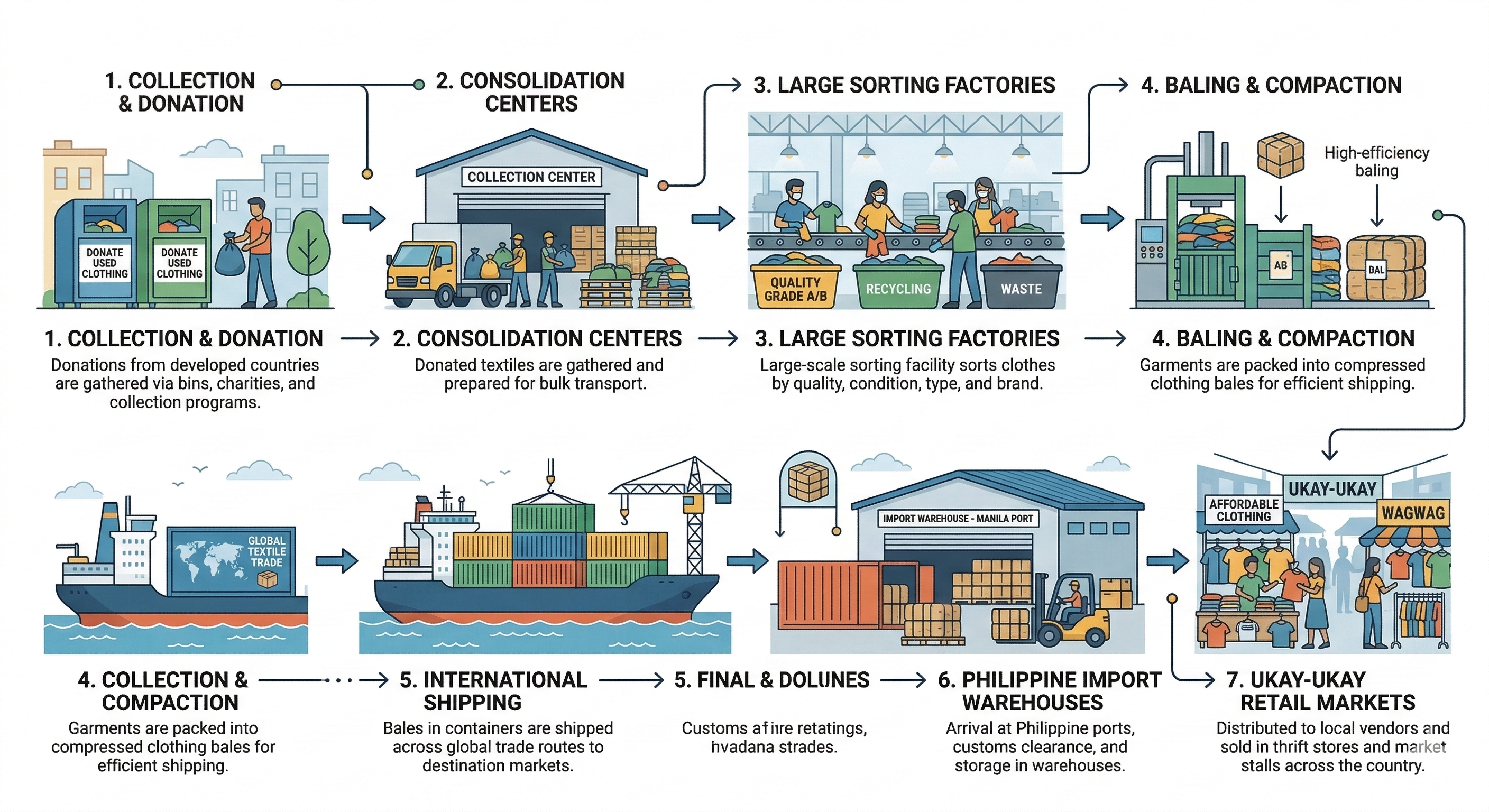
A repeatable worksheet makes pricing faster and prevents costs from disappearing between departments. Keep one tab or section for shipment inputs, one for processing results and one for sales performance. The same field names should be used for every lot so results can be compared over time.
The shipment section should record supplier, purchase order, lot reference, trade term, currency, exchange rate, payment fees, invoice value, freight, insurance, duty, tax, brokerage, port charges and warehouse delivery. Store the source document or invoice reference beside each number. If a cost is estimated, mark it clearly and replace it when the invoice arrives.
The processing section should record received gross and net weight, bale count, piece count, labor hours, cleaning, repair, packaging, sellable output and residue. Do not overwrite the original supplier specification. Keeping the promised and received values side by side makes deviations visible.
The sales section should record category, allocated cost, regular price, markdown price, units sold, returns, realized revenue and days in inventory. This converts the worksheet from a purchasing calculator into a feedback system. The next purchase decision can then use realized output and prices rather than memory.
Use controlled formulas and protect cells that contain them. A broken reference can make a profitable-looking report from incorrect inputs. When several employees use the sheet, add a short definition for fields such as “sellable,” “repairable,” “clearance” and “residue” so everyone classifies output the same way.
Currency, payment and timing adjustments
International orders can change cost between quotation and final payment. If the supplier invoice, freight and local sales use different currencies, record the exchange rate used for each payment rather than applying today’s rate to the whole shipment. Bank spreads and transfer fees should be allocated to the lot.
Payment timing also matters. A deposit may be paid weeks before the balance, freight and duty. During that period, working capital is unavailable for other inventory. Businesses that borrow for purchases should include attributable financing cost when evaluating the lot, even if it is reported below gross margin in the accounting system.
Delayed arrival can reduce selling value. A seasonal category delivered after its main demand window may require earlier markdowns. The landed-cost formula does not change, but the expected revenue and selling period should be revised. This is why the conservative scenario should include a time delay, not only a lower sellable ratio.
For quotations with a short validity period, keep the supplier price, freight estimate and exchange-rate assumption separate. That allows one variable to be updated without rebuilding the full model.
Validate the model against cash received
Projected revenue is not the final test. Reconcile the model with cash actually received after discounts, platform fees, refunds and customer returns. If sales occur on credit, distinguish invoiced revenue from collected cash.
At the end of a cycle, compare projected and realized results:
- projected versus received sellable pieces;
- planned versus actual processing hours;
- listed versus realized price;
- expected versus actual markdown rate;
- expected versus actual selling period;
- projected versus collected gross profit.
Large differences require an explanation. A low margin may come from a supplier-specification problem, an inaccurate demand forecast, excessive processing, late arrival or poor price discipline. Identifying the source is more useful than labelling the entire shipment “good” or “bad.”
Use the variance to update the next expected, conservative and poor scenarios. After several comparable lots, the business develops its own evidence-based pricing range without relying on generic industry percentages.
Trial-lot pricing scorecard
For every sample bale or shipment, record:
- supplier and lot reference;
- specification, category and nominal weight;
- purchase and landed cost;
- received weight and piece count;
- labor hours and processing cost;
- premium, standard, clearance, repair and residue outputs;
- sellable pieces and kilograms;
- average allocated cost;
- realized revenue and gross margin;
- days to sale-ready and sell-through milestones;
- complaints, returns and specification deviations.
When onsite inspection is unavailable, follow a structured remote used-clothing bale inspection process and retain evidence linked to the lot.
Common resale pricing mistakes
Using supplier price as total cost
Freight, duty, destination handling and processing can materially change the cost base.
Dividing by all pieces received
This understates the cost of inventory that can actually be sold.
Copying a universal sellable ratio
Yield varies by specification, category, source and market. Measure the buyer’s own lots.
Treating markup as gross margin
The formulas use different denominators and produce different prices.
Applying one price to a mixed lot
Category demand and processing cost differ. Use a tiered or category-level price plan.
Ignoring selling time
Slow stock consumes space and working capital even when its nominal margin looks attractive.
Pricing from competitors’ asking prices
Use realized local sales whenever possible. Listings that remain unsold can make the market appear stronger than it is.
Frequently asked questions
What is the first number needed for resale pricing?
Start with total landed and processing cost, not only the supplier invoice.
How do I calculate cost per sellable item?
Add landed and processing costs, subtract reliable residue recovery, and divide by the number of pieces that fit an available sales channel.
What sellable percentage should I assume?
There is no universal percentage. Use measured trial lots and calculate expected, conservative and poor scenarios.
Is markup the same as gross margin?
No. Markup is profit divided by cost, while gross margin is profit divided by selling price.
Should used clothing be priced by kilogram or piece?
Use the unit that matches the channel. Piece pricing suits retail, while kilogram pricing can suit wholesale redistribution. Track both internally.
How often should prices be reviewed?
Review by category and selling cycle. Use sell-through milestones and season deadlines rather than changing prices randomly.
Can a high-grade bale guarantee a high resale price?
No. Condition grade does not guarantee style, brand, size, season or destination-market demand.
Build pricing from measured output
The correct resale price is not a fixed multiple of bale price. It is the result of landed cost, processing, sellable output, category demand, sales-channel expenses and required cash-conversion speed.
Use a trial-lot scorecard, keep category results separate and revise assumptions with realized sales. For a used-clothing quotation, contact Indetexx with your destination, target categories, grade requirements, bale weight and planned volume.
Request a Bale Specification for Your Cost Model
Share your destination, target categories, grade expectations, preferred bale weight and volume. Indetexx can discuss a quotation and specification that you can place into your landed-cost worksheet.