When you compare buying a used-clothing auction lot with placing a direct sorted order, do not start with the bid and the quotation. First confirm that both offers describe comparable goods. Then check the evidence, fees, deadlines and written terms attached to each offer. Price becomes useful only after those differences are visible.
The practical choice is not “cheap stock” versus “reliable stock.” An auction lot can work when the listing is specific enough and your team can absorb the sorting and resale uncertainty that remains. A direct sorted order can work when you can write a useful specification and manage the order and logistics it requires. Neither route establishes your sellable yield or margin before you receive the goods.
First, identify which auction model you are looking at
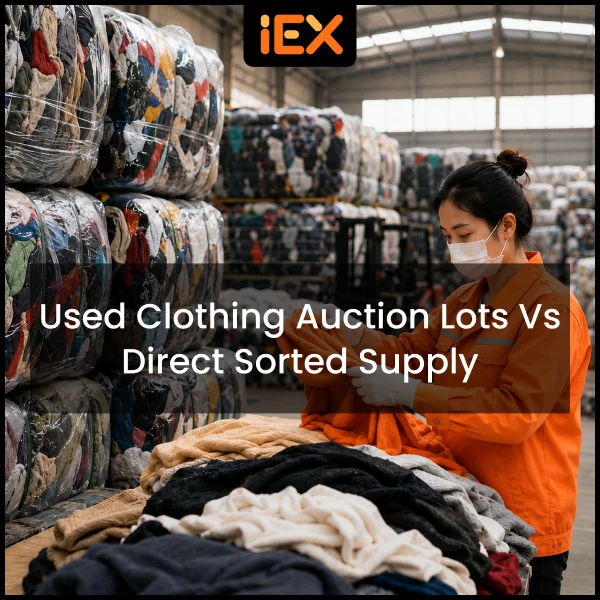
The word auction is used for several different transactions. If you do not identify the mechanism, you may compare prices that were formed in completely different ways.

In a buyer-bid inventory auction, a seller offers a fixed lot and buyers compete for it, usually by bidding upward. The lot already exists, so the listing, lot ID, condition description, photographs, manifest and inspection access matter. Whether the top bid completes the purchase depends on the current platform, listing and seller terms.
A reverse auction works in the other direction. Suppliers compete to satisfy a buyer’s requirement and may revise their offers downward. The official Federal Acquisition Regulation definition of a reverse auction describes this procurement mechanism; it is not the same as buyers bidding for an existing bale or pallet. Calling both transactions “auction sourcing” hides who defined the goods and who is bidding.
A fixed-price marketplace listing is another model. The goods may sit on the same platform as auction lots, but the price is posted rather than produced by bidding. Direct sorted supply is different again: the buyer and supplier discuss an order and its category, grade, exclusions, weight basis, packing and commercial terms. Here, direct does not necessarily mean buying from the original manufacturer. In used clothing, it means negotiating a supply order rather than bidding for a fixed inventory lot.
None of these mechanisms tells you whether the stock is used clothing, returns, overstock, liquidation stock or another inventory class. Auction is a selling method, not a grade or condition. If the listing uses those terms loosely, separate them with this guide to used clothing, liquidation and overstock before comparing the offer.
Match the goods before you compare auction and direct prices
Two prices compete only when the underlying goods serve the same buying task. For example, an auction lot described only as unsorted clothing on a gross-weight basis is not a direct substitute for a sorted women’s-tops order quoted by net product weight. Even if both are packed in bales, their processing work and resale routes differ.

Start by matching the product definition. Confirm the stock source or condition class, category, season, grade definition, exclusions, allowed substitutions, net or gross weight basis, packing unit and intended sales channel. If an auction listing does not disclose one of these fields, mark it as unknown. Do not fill the gap with the direct supplier’s specification or with an assumption based on a similar-looking lot.
Use the same short product brief for both offers:
- category and selling season;
- condition or order-specific grade boundary;
- excluded items and permitted substitutions;
- net or gross weight basis;
- bale, bag, pallet or other packing unit;
- intended resale channel; and
- lot-specific evidence and available inspection.
If your real decision is whether to buy original material or prepared categories, resolve that processing-state question first with the comparison of credential clothing and sorted bales. Then return to the auction-versus-direct comparison with one product state selected.
A broad “Grade A” label is not enough for a direct quote. Indetexx uses order-specific category and Grade A/B/C definitions, so ask for the category, grade boundary, exclusions, weight basis, substitutions and packing to be written into the current quotation or purchase specification. A used clothing bale specification sheet helps organize those fields. The classification process creates a clearer basis for discussion; it does not guarantee a fixed category mix, defect rate or sellable yield in a particular shipment.
Used clothing auction vs direct sourcing: what actually changes
Once the goods are aligned, compare where each route leaves control and uncertainty. The table is designed for a fixed auction lot and a directly negotiated sorted order—not for every marketplace, contract or supplier.
| Decision point | Fixed auction lot | Direct sorted order | Buyer action |
|---|---|---|---|
| Price basis | Winning bid plus any current buyer premium, platform charge and required service fee | Quoted price on a stated weight, packing and delivery basis | Record what the price includes and excludes before comparing it |
| Product definition | Limited to the exact listing, lot description and seller representations | Category, grade, exclusions and substitutions may be negotiated in a current written specification | Align the same category, condition and weight basis |
| Evidence and inspection | Photographs, manifest, viewing or sampling depend on the lot and platform | Evidence or inspection requests can be discussed before the order, subject to current agreement | Tie every source of evidence to the lot ID or order |
| Fees and deadlines | Platform and seller rules may add payment, pickup, storage or other obligations | The quotation and contract should state payment, delivery and other agreed commercial terms; omissions remain unknown until confirmed | Put all applicable charges and dates on one timeline |
| Receiving work | Unresolved variability may require more inspection, sorting, rework and re-routing | Agreed sorting can reduce some preparation work, but receipt still needs checking against the order | Confirm that space, labor and resale routes can handle the remaining work |
| Remedy and notice process | Current platform, seller and lot terms control what may be raised and when | Current purchase terms can define conformity, notice and any agreed remedy | Read the trigger, deadline and available remedy before payment |
| Repeat use | Every new lot requires its own evidence and decision | A later order can reference a prior specification and buyer feedback, but still needs current confirmation | Use auctions for defined opportunities and direct orders for categories your records can support |
Use the final column as the working test. A direct sorted order is not automatically lower-risk because it has a specification, and an auction lot is not automatically poor quality because buyers bid on it. The practical difference is how much you can define before payment, what remains unknown, and whether your operation can handle that uncertainty after arrival.
Check lot evidence, fees, deadlines and remedies before payment
Collect the current evidence and terms before you calculate cost. A low bid is misleading if the buyer premium is missing, the listed weight includes packing, or the pickup schedule creates charges your warehouse cannot avoid. A detailed direct quote is also incomplete if it does not state the delivery basis, packing, weight basis or applicable notice terms.

Marketplace rules are useful examples, not universal auction law. The Liquidation.com user agreement shows that sale formats, inspection limits and the contract attached to a listing can affect the transaction. B-Stock’s buyer guidance likewise shows why as-is wording and the seller’s current Terms of Purchase must be read before bidding. These pages do not prove that another marketplace or lot uses the same rules.
Build a pre-payment record for the exact lot or order. It should identify:
- the listing, order and lot ID, plus the date the information was captured;
- the written product description, photographs, manifest coverage and any stated limitations;
- inspection, viewing or sampling access and what it actually covers;
- the bid or quote basis, buyer premium, platform fees and other stated charges;
- payment, collection, pickup and storage deadlines that apply;
- the current platform, seller or purchase terms;
- the discrepancy or non-conformity notice deadline and the remedy wording available under those terms; and
- buyer eligibility, receiving-address and export-document conditions when the order crosses borders.
For international buyers, eligibility and document support can change by seller, marketplace, listing and destination. B-Stock’s international-buyer guidance is one platform-specific example of those limits. Verify the current rule for the actual transaction rather than relying on a previous purchase or a general country list.
A manifest helps identify what the seller says is in a lot, but it is not a guarantee of condition, quantity accuracy or resale performance. Ask whether images show the exact lot, whether they are current, and whether an inspection sample represents the full lot. The remote bale inspection guide provides a fuller pre-payment method. If the evidence cannot be tied to the lot—or your team cannot meet the stated notice deadline—treat the offer as more uncertain or walk away.
Compare estimated cost before buying—and realized cost after receiving
Only now should you compare cost. Government trade guidance on determining a total export price explains why product price may be only one input alongside applicable freight, tariffs, taxes and other fees. Your transaction may also include origin handling, export packing, insurance, destination handling, brokerage, final delivery, inspection, sorting, rework or disposal. Use only the items that actually apply, with their source and date.

Before payment, calculate a planning estimate rather than pretending to know the receiving result:
Estimated cost per scenario accepted-saleable kg = (known current purchase, fee, freight, import and handling amounts + explicitly labelled buyer scenario allowances) / (scenario accepted-saleable kg)
The accepted-saleable kilograms in this estimate are not a measured yield. Use only your own comparable receiving history or a clearly labelled scenario or range. The history must be genuinely comparable in product class, evidence quality and processing work. If you do not have a defensible input, leave it unknown; do not replace it with a supplier percentage or an optimistic assumption.
The delivery basis also needs to match. The ICC Incoterms rules help allocate specified delivery tasks, costs and risks when the rule and named place are stated. They do not determine product quality, title, payment, remedies or whether the goods can legally be imported. If the Incoterm and named place are missing from a direct quote—or the auction’s pickup point and handover obligations are unclear—pause the comparison.
After receipt, replace scenarios with recorded outcomes:
Realized cost per accepted-saleable kg = (actual applicable landed cost + actual inspection, sorting, rework and disposal cost) / (actual kg accepted for the intended sales channel)

This number cannot be completed before the goods arrive. It may differ from the estimate because the actual route costs, processing work and accepted kilograms are now known. A lower winning bid can therefore produce a higher realized cost, while a higher direct quote can still require unplanned work; the result depends on your records, not the sourcing label.
After receiving, the actual receiving record supplies the cost and accepted-kilogram inputs needed for this check. For the detailed receiving-to-reorder correction method, use the guide to why clothing bale quality changes between repeat orders.
For a deeper breakdown of freight, handling and shipment-level inputs, see the guide to landed cost per kilogram. Keep that calculation separate from any profit forecast: this comparison establishes cost visibility, not the selling price or margin your market will deliver.
Choose the route your receiving operation can control
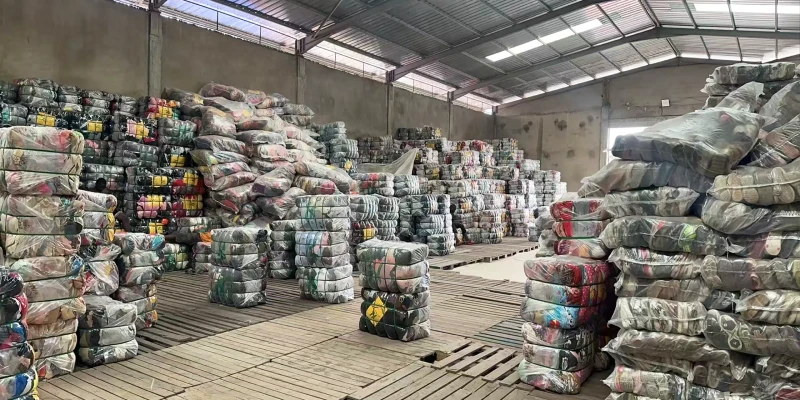
The right route is the one your operation can receive, inspect, process and sell—not the one with the simplest headline. Make the decision against your actual warehouse space, sorting and rework capacity, local handling and disposal requirements, category sales records, and the maturity of your written specification.
Choose an auction lot for a defined opportunity
Auction inventory can fit a one-off purchase when the exact lot supports a category your business already knows. The evidence must be sufficient for the decision, the total pre-payment estimate must include the current fees and route costs, and your team must be able to inspect, sort, rework or re-route pieces that do not fit the intended channel.
For example, a wholesaler with established outlets for several condition bands may be able to redirect usable pieces from a variable lot. A buyer serving one narrow boutique category may have fewer recovery routes. The difference is not general “risk tolerance”; it is the receiving and resale work the business can actually perform.
Choose direct sorted supply for a repeatable core category
Direct sorted supply fits better when the category is central to your sales plan and you can describe it in writing. A mature brief gives both parties a reference for category, grade boundary, exclusions, substitutions, weight basis and packing. It also makes the quotation easier to compare with your receiving records. It does not remove the need to inspect the order when it arrives.
If shipment handling is the concern, Indetexx can discuss mixed or category-specific bales, bale and packing requirements, and planning for 20-foot or 40-foot container options. Send the destination, sales channel, category, exclusions, bale-handling limits and packing needs, then ask which options are currently feasible for the quotation. Availability, loading quantity, lead time and composition remain specific to the current order; the capability statement does not promise them.
Use a hybrid only when the routes have different jobs
A hybrid approach can make sense when direct sorted orders cover proven core categories and auction lots serve clearly defined opportunities. Keep separate product briefs, evidence files and cost scenarios for each route. Do not use “hybrid sourcing” to avoid deciding what the core category needs or to average an uncertain lot into a direct-order result.
The decision should remain visible: which category each route serves, what uncertainty it leaves, who owns the receiving work and which resale outlet can absorb the result. If those answers are missing, adding a second sourcing route adds complexity rather than useful flexibility.
Prepare a comparable offer file before you commit
Put the decision in one file before anyone approves the bid or purchase order. This prevents a photograph from one lot, a fee from another listing or a yield assumption from an old order being treated as current evidence. It also makes a later review more useful because your team can see what was known, estimated and unresolved at the time.
Record:
- the seller, supplier, listing, order and lot identifiers;
- the matched product, condition and weight basis;
- the source and date for each image, manifest, specification or inspection item;
- current fees, payment, pickup, storage and notice terms;
- the Incoterm and named place or the auction handover point;
- known cost inputs and their source dates;
- scenario ranges and the comparable internal record used, if any;
- unresolved unknowns and the receiving work they may create; and
- the selected route, approval owner and decision date.
Do not force the file to produce a winner. If a material product field, cost input or term remains unknown, show the gap and decide whether your operation can accept it. Walking away from an offer that cannot be compared is a valid sourcing decision.
Compare a Direct Sorted Quote with Your Auction Option
Indetexx can discuss current category, grade, bale, packing and container options for a direct sorted quotation. Send your destination, sales channel, exclusions, handling limits and shipment plan, then ask what is currently feasible.
- ✓ Category, grade, exclusions and weight basis written for the current quote
- ✓ Bale, packing and container-option feasibility confirmed for the order
- ✓ Current commercial, shipment and evidence terms stated before comparison