On June 3, 2026, the UK Environment Agency published new guidance that redefines how the UK used clothing export rules 2026 operate in practice. The guidance clarifies when exported used clothing qualifies as “non-waste” and when it may be classified as waste under existing law. It does not create a ban on used clothing exports, but it shifts the burden of proof squarely onto exporters to demonstrate that shipments are fit for direct reuse.
This marks a significant moment for the global secondhand clothing trade — not because the UK is the largest player, but because its approach provides a regulatory template that other markets are likely to follow.
Quick Takeaways
- The UK Environment Agency guidance (June 3, 2026) clarifies existing waste law for used textile exports — it is not a ban, but it makes compliance requirements explicit.
- Exporters must now proactively demonstrate that shipments meet four “non-waste” criteria covering sorting quality, documentation, destination market demand, and valid commercial orders.
- Mixed, damaged, or unsorted shipments face the highest risk of being classified as waste, triggering stricter waste shipment controls.
- Importers buying used clothing from UK suppliers need to verify that their supplier can provide documented sorting records and evidence of direct reuse suitability.
- The guidance applies directly to England (Environment Agency jurisdiction), but sets a de facto best-practice standard across the UK and aligns with global trends under the Basel Convention.
- Unsorted bales — common in lower-cost transactions — carry the greatest regulatory risk under the new framework.
- Professional sorting and documentation systems are no longer just a commercial advantage; they are becoming a compliance requirement.
Why the UK Used Clothing Export Rules 2026 Matter Beyond the UK
The used clothing trade has operated for decades under a relatively loose regulatory framework. Shipments move from developed to developing markets under broadly defined categories, and waste classification has rarely been enforced against wearable secondhand clothing. The UK used clothing export rules 2026 change this dynamic by putting operational detail around a question the industry has long avoided: when is used clothing actually waste?
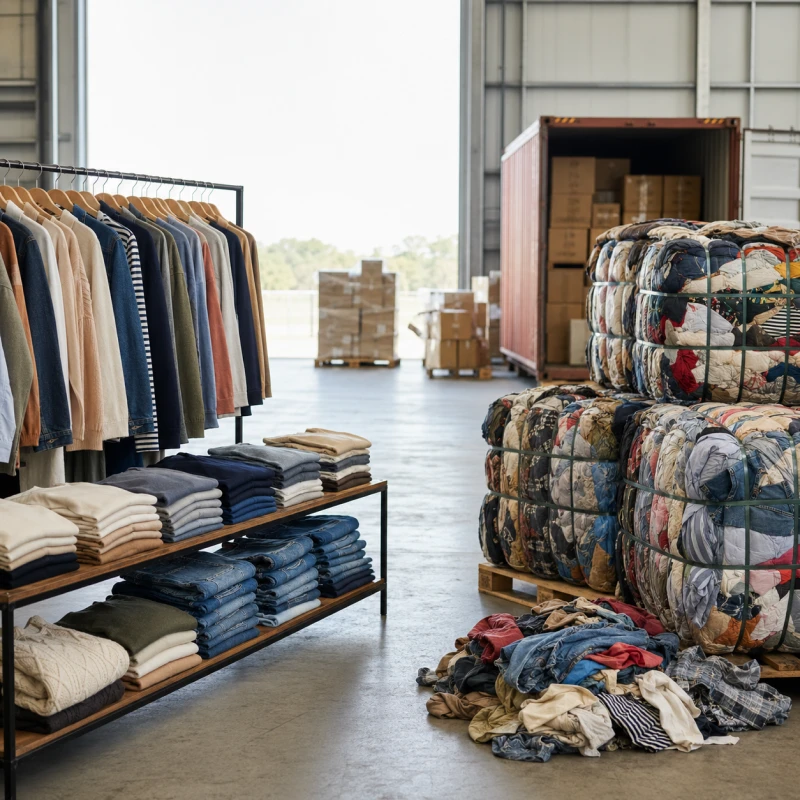
The significance is not limited to UK exporters. The UK is one of the largest exporters of secondhand clothing globally, with significant volumes going to Africa (Ghana, Kenya, Tanzania, Uganda) and parts of Asia. But more importantly, the guidance arrives alongside parallel discussions at the Basel Convention’s OEWG-15 meetings, where similar questions about used textile classification are being debated. The UK has effectively produced the first concrete regulatory template for what “prove it’s not waste” looks like in practice.
For importers worldwide, this means that regulatory scrutiny on used clothing shipments is trending in one direction: toward requiring evidence of genuine reusability. Whether you buy from the UK, Europe, or directly from major sorting facilities in Asia, the standard of proof you will need to provide is rising.
What the Environment Agency Guidance Actually Says
The guidance, published on June 3, 2026, by the UK Environment Agency, applies to England. Wales (regulated by Natural Resources Wales) and Scotland (regulated by SEPA) have separate regulatory frameworks, but the guidance is widely expected to function as UK-wide best practice. In practice, because the UK’s primary textile export ports — Felixstowe, Southampton, and London Gateway — are located in England, any shipment routed through these ports must comply with the Environment Agency’s standards regardless of its inland origin.
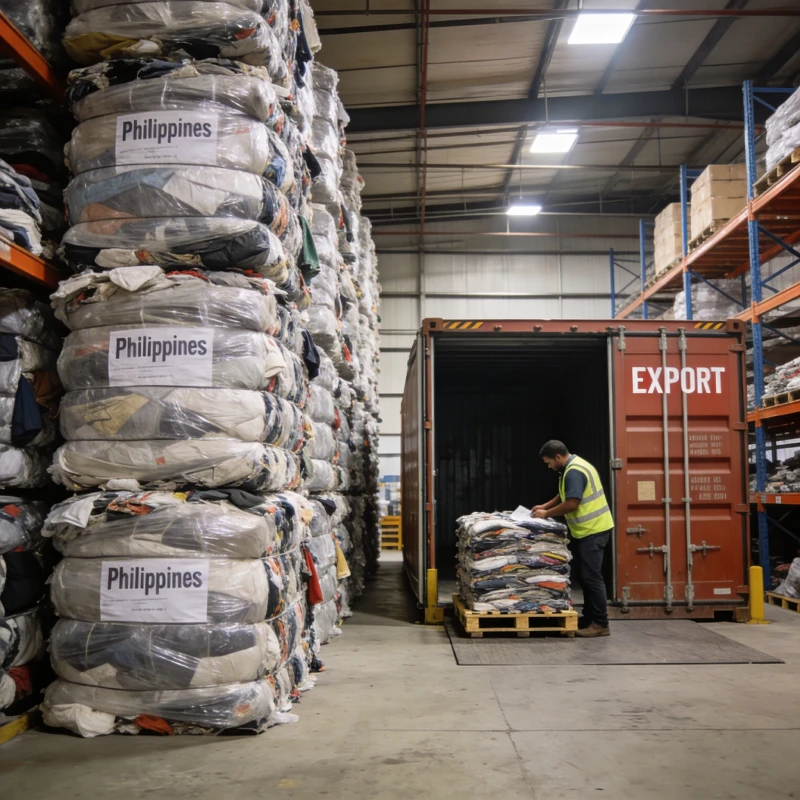
The core purpose of the guidance is to clarify when used textiles qualify as “non-waste” for export, rather than introducing new legal restrictions. Under UK law, the definition of waste already covers materials that are discarded, intended to be discarded, or required to be discarded. The guidance applies this existing definition to used textiles specifically.
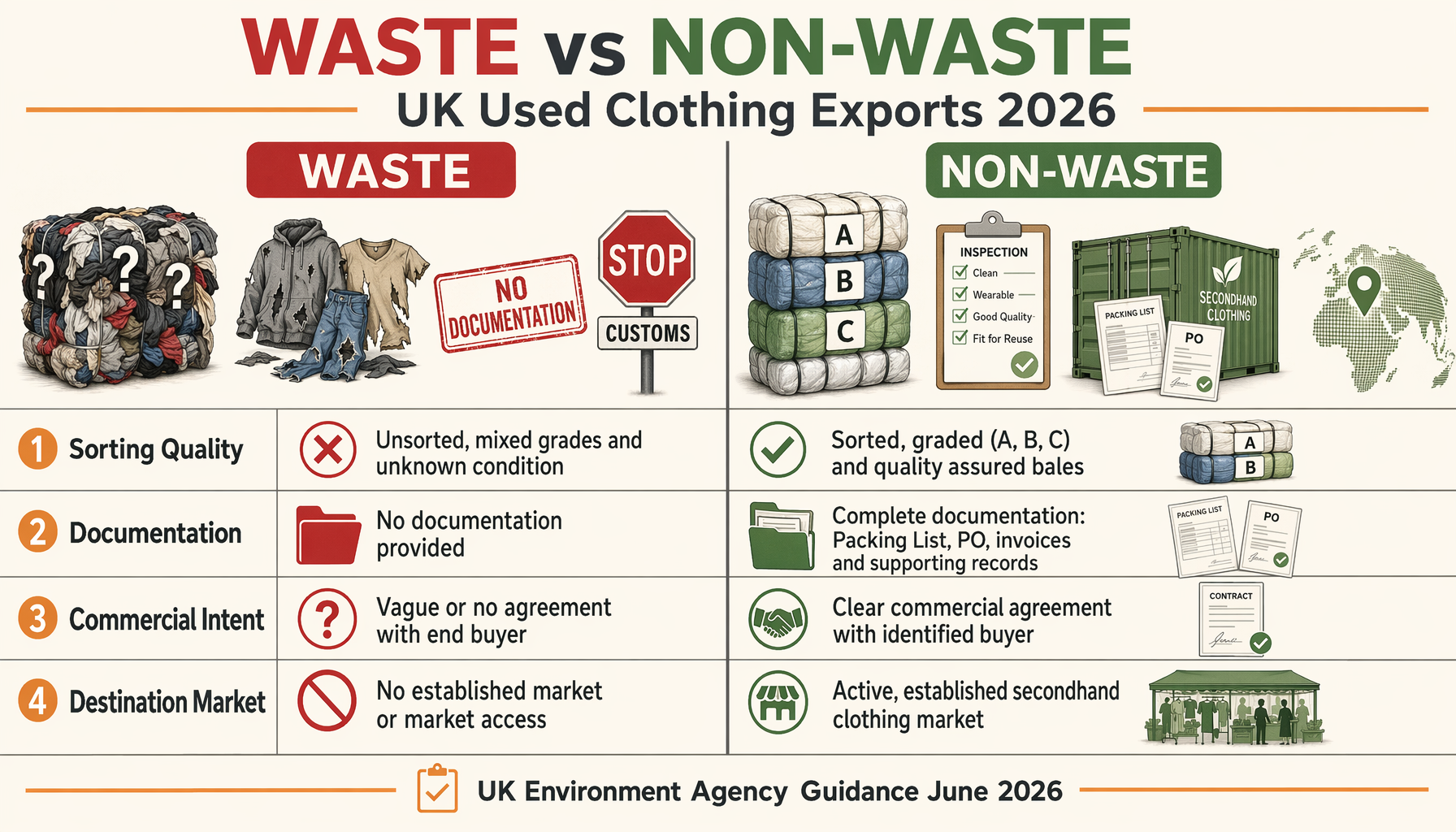
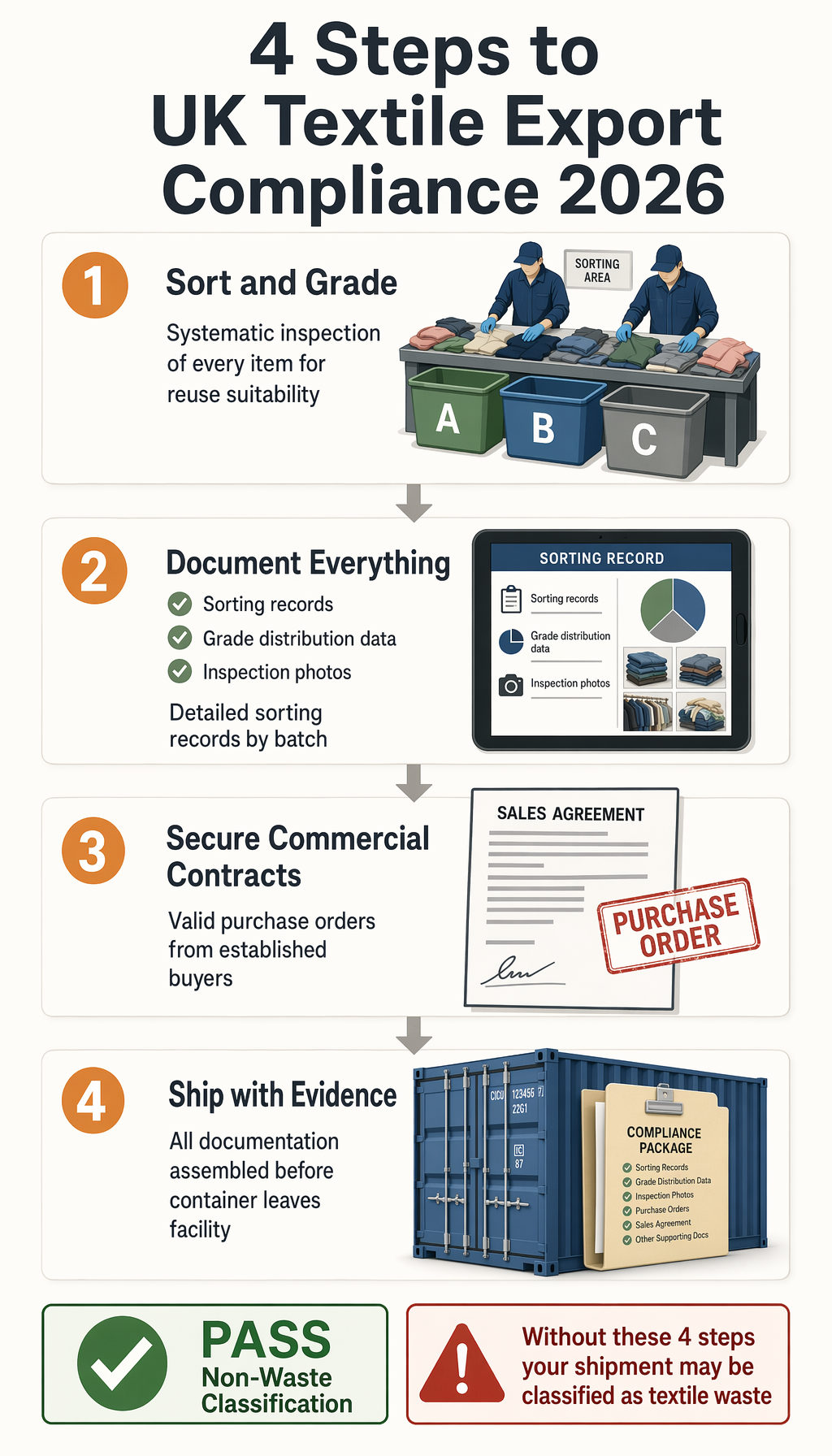
Four criteria determine whether exported used clothing qualifies as non-waste:
- Direct reuse suitability: Items must be suitable for direct reuse without further processing. This means they must be functional, free from significant stains or damage, and wearable in their current condition.
- Destination market demand: The destination country must have an active market for secondhand clothing of the type being exported. Shipments to countries without established markets raise red flags.
- Valid commercial arrangements: The exporter must have genuine contracts, purchase orders, or equivalent commercial documentation demonstrating that the goods are being sold, not discarded.
- Documented sorting and inspection: The exporter must have a documented sorting and inspection process that can demonstrate how items were assessed for reuse suitability.
The critical shift here is the burden of proof. Previously, exporters could ship used clothing without actively demonstrating non-waste status — the default assumption was that wearable clothing was not waste. Under this guidance, the exporter must be prepared to evidence all four criteria if asked. The guidance also allows exporters to present evidence explaining why further sorting is not needed for a particular shipment, which provides some flexibility for legitimate transactions.
For importers working with suppliers who operate professional sorting facilities, these four criteria map directly onto standard operating procedures. Documented batch-level sorting, grade distribution records, and quality inspection logs — the same infrastructure that ensures product consistency — also satisfy all four non-waste criteria. This alignment means that choosing a supplier with established sorting and documentation systems is not just a quality decision, but a regulatory compliance decision.
A key operational change that many exporters overlook is the timing of compliance preparation. Evidence — sorting records, inspection documentation, grade distribution data, and commercial contracts — must be fully assembled before the container leaves the sorting facility, not compiled reactively if customs raises questions at the port. An exporter who waits until a shipment is flagged to gather documentation has already failed the compliance test.
“Waste” vs “Non-Waste”: The Practical Difference
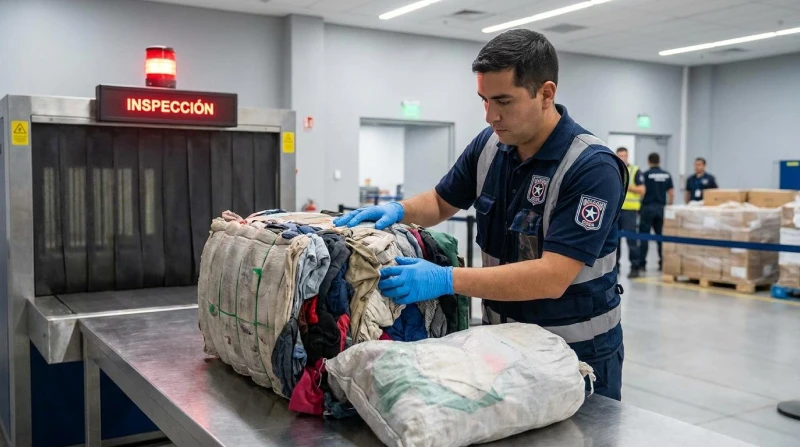
The four criteria sound straightforward in theory, but the practical distinction between waste and non-waste depends heavily on how a shipment is prepared and documented.
What Makes a Shipment “Waste”
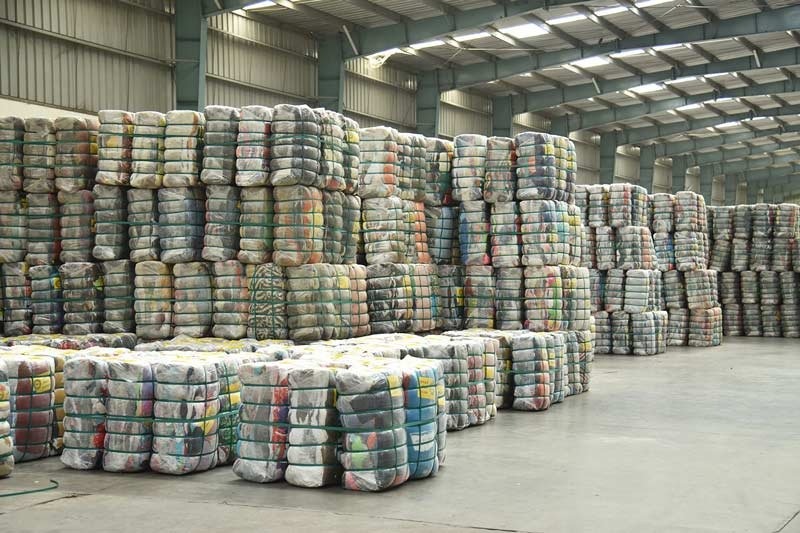
The highest-risk shipments under the guidance are those that are mixed, damaged, or unsorted. A container of unsorted used clothing — containing a mix of wearable items, damaged textiles, and non-textile materials — would be difficult to classify as non-waste because the exporter cannot demonstrate that the contents are suitable for direct reuse without further processing.
Consider two scenarios:
Scenario A — Low risk: A shipment of Grade A sorted used clothing packed in standard bales, accompanied by a packing list showing item categories, a quality inspection record, and a purchase order from a known importer in a market with established secondhand clothing demand. The exporter can produce records showing the sorting criteria applied and the approximate percentage of items in each grade.
Scenario B — High risk: A shipment of unsorted mixed used clothing in bales, with no packing list beyond total weight, no inspection records, and a vague purchase agreement with a buyer in a market that has no established secondhand clothing infrastructure. The exporter cannot demonstrate what is actually in the bales or whether the contents are fit for reuse.
Under the guidance, Scenario B faces a realistic risk of being classified as waste. The exporter would need to present evidence why further sorting is unnecessary — an uphill argument without documented sorting processes.
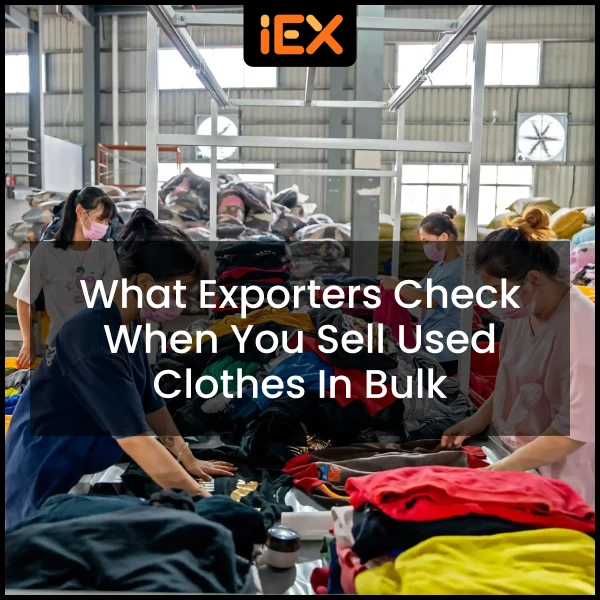
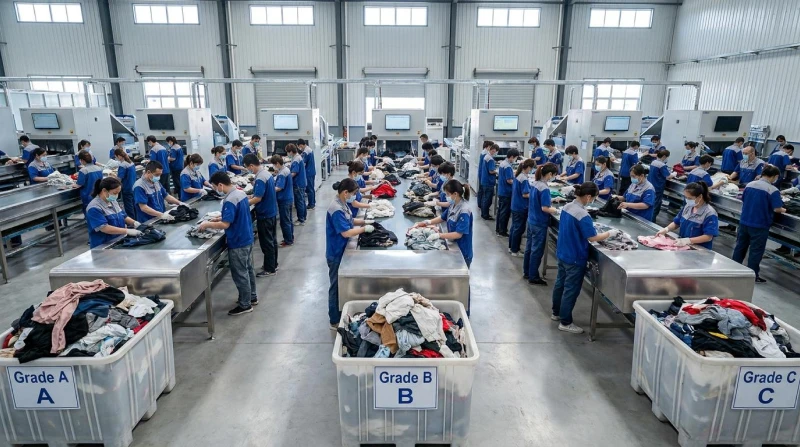
Importantly, professional sorting does not mean achieving flawlessness on every item. The regulatory requirement centers on systematic processes: removing contaminants (non-wearable textiles, non-textile materials, heavily damaged goods) and transparently classifying remaining items into defined grades — Grade A (direct reuse), Grade B (minor defects, still wearable), Grade C (textile recycling) — that correspond to different market channels. Clear grade definitions supported by documented sorting records — not unrealistic zero-defect standards — are what satisfy the Environment Agency’s evidence requirements. For importers, this means a supplier who can demonstrate consistent sorting methodology and grade transparency provides stronger regulatory protection than one who cannot, even if both suppliers’ output contains some lower-grade items.
Borderline Situations
Not every shipment fits neatly into waste or non-waste. Borderline cases include:
The guidance helps exporters self-assess by providing clear criteria. The key question for any shipment is: can you produce evidence for all four non-waste criteria?
What This Means for Importers Buying from the UK
Importers who purchase used clothing from UK-based suppliers are directly affected by the UK second-hand clothing export regulations, even though they are not the exporting party. If a UK exporter’s shipment is classified as waste, it can be detained at the port, reclassified, or returned — delaying delivery and creating financial exposure for the buyer.
Documentation to Request from UK Suppliers
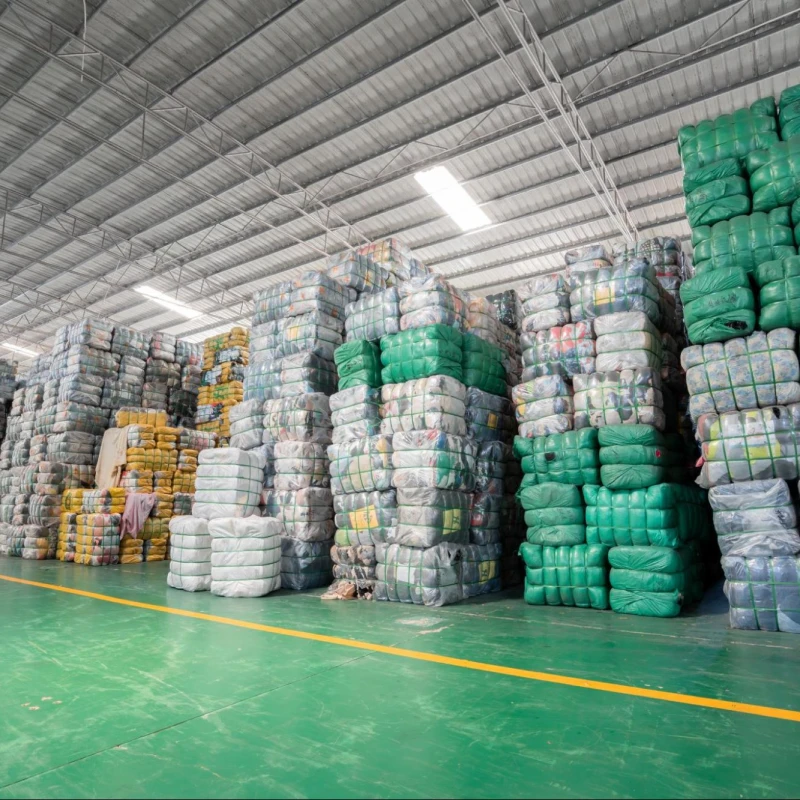
Importers should request the following from any UK-based supplier before committing to a shipment:
- Sorting records: Documentation of the sorting process applied to the bales, including grade criteria and inspection methodology
- Packing lists: Detailed lists showing contents by category and grade, not just total weight
- Commercial contracts: Valid purchase orders or sale agreements demonstrating genuine commercial intent
- Quality assurance documentation: Evidence of quality control processes, ideally with photographs or inspection checklists
A supplier who cannot provide these documents is operating at higher regulatory risk. The same due diligence framework used to evaluate any used clothing supplier applies here, but with an additional layer: regulatory compliance verification.
Due Diligence Questions
Before placing an order with a UK supplier, ask:
- Do you sort and grade your used clothing before baling?
- Can you provide documentation of your sorting process and inspection criteria?
- Do you maintain records linking specific shipments to specific quality checks?
- Can you demonstrate that your destination market has established demand for secondhand clothing?
- Do your contracts include specifications about the minimum quality standard of the contents?
A used clothing buying checklist is a practical tool for this process. The same discipline that protects you from poor-quality shipments now also protects you from regulatory delays.
Quality Standards in Contracts
Importers should specify minimum quality standards in their contracts with UK suppliers. Grade definitions — such as the widely used Grade A (no stains, no tears, minimal wear), Grade B (minor defects, still wearable), and Grade C (textile recycling only) — provide a common language that aligns with the guidance’s requirement for documented sorting.
If your supplier uses a grading system for used clothes, demand to see it documented. If they do not use a formal grading system, this is itself a red flag under the 2026 guidance.
Connection to the Basel Convention and Global Regulatory Trends
The UK guidance does not exist in isolation. At the international level, the Basel Convention’s OEWG-15 (Open-Ended Working Group) has been examining how used textile shipments are classified under the Convention’s waste definitions. The direction of these discussions mirrors the UK approach: toward requiring exporters to provide evidence that used clothing shipments are genuinely intended for reuse, not disguised waste disposal.
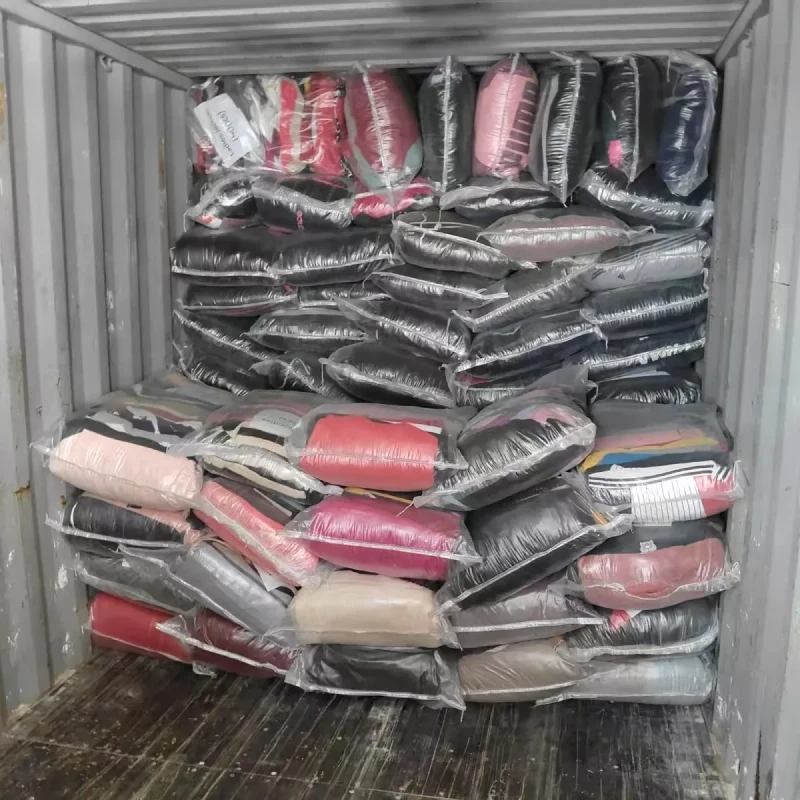
What makes the UK guidance significant is that it translates this international discussion into operational, enforceable criteria. The Basel Convention process moves slowly, and its technical guidelines are negotiated among parties. The UK has moved ahead with a domestic framework that could serve as a reference model for other countries developing their own classification standards.
For the used clothing trade, the direction is clear. The era of shipping unsorted mixed bales with minimal documentation is closing. The regulatory environment is shifting from “presumed non-waste unless proven otherwise” to “must demonstrate non-waste status.” This affects all participants in the supply chain, from exporters in developed markets to importers in destination countries.
Indetexx monitors these regulatory developments across all major global markets and incorporates compliance considerations into its export procedures. The same sorting and documentation infrastructure that ensures quality consistency also serves as regulatory protection.
Sorting Quality as Regulatory Compliance
The most important implication of the UK guidance — and the broader regulatory trend it represents — is that sorting quality is no longer just a commercial differentiator. It is becoming a compliance requirement.
How Professional Sorting Addresses Regulatory Concerns
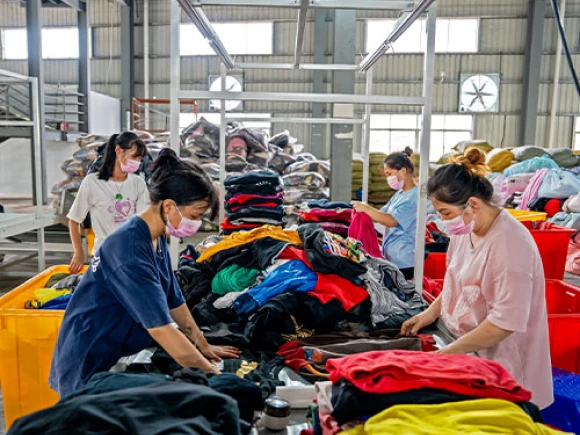
The four non-waste criteria are, in practice, a description of what a professional sorting operation does every day:
- Direct reuse suitability: Achieved through systematic inspection and grading of individual items
- Destination market demand: Informed by market analysis and demand planning
- Valid commercial arrangements: Standard business practice for any legitimate exporter
- Documented sorting and inspection: The core process of any professional sorting facility
An exporter using manual or ad-hoc sorting without documentation cannot readily demonstrate compliance. A supplier with established sorting and grading infrastructure can produce evidence across all four criteria as a byproduct of normal operations.
Documentation Systems and Transparency
The guidance does not prescribe a specific documentation format. What matters is that the documentation exists and can be produced on request. Systems that track sorting by batch, record grade distribution, and link shipments to inspection records provide the strongest evidence.
Indetexx operates its own quality control systems and documented sorting processes at its 20,000 m² facility, with the capacity to handle 6,000 tons of used clothing monthly. Every shipment undergoes strict quality control checks, and sorting parameters are recorded and traceable. When a regulatory framework requires an exporter to demonstrate direct reuse suitability and documented sorting, this infrastructure becomes a direct compliance asset.
The same applies to raw material quality. Suppliers who work with consistent, quality-graded raw materials are better positioned to demonstrate that their outputs meet direct reuse standards, because the input quality is already controlled.
The Competitive Advantage of Quality Infrastructure
When sorting was purely a commercial choice, lower-cost suppliers could compete by offering unsorted or minimally sorted bales at lower prices. The UK guidance — and the global trend it signals — removes that option for suppliers who want regulatory certainty. Unsorted bales now carry a compliance risk that must be priced into the transaction.
This shifts the competitive balance toward suppliers with established sorting infrastructure. The upfront cost of professional sorting becomes a regulatory investment, not just a quality investment. Importers who work with such suppliers gain not only better product consistency but also lower regulatory risk.
Indetexx has invested in sorting capabilities and quality systems precisely because the commercial logic was always clear — better sorting means better Grade A used clothing output, fewer customer complaints, and stronger long-term relationships. That the same infrastructure now also serves as regulatory compliance documentation is a natural alignment, not an accident.
Environmental Responsibility and Regulatory Alignment
The UK guidance also reflects a broader push for environmental accountability in the used clothing export to Africa trade and other destination markets. The environmental case for professional sorting — extending product lifecycles, diverting textiles from landfill, ensuring that only genuinely unusable textiles enter recycling streams — aligns directly with the regulatory objective of preventing waste dumping under the cover of used clothing exports.
Suppliers who treat sorting as a sustainability practice rather than a cost center are better prepared for both current regulations and future tightening.
Frequently Asked Questions
Did the UK ban used clothing exports in 2026?
No. The UK Environment Agency published guidance clarifying existing waste classification rules for used textile exports. It is not a ban, and used clothing can still be exported from the UK if the exporter can demonstrate it qualifies as non-waste. The misconception that the UK banned exports has caused unnecessary concern in the industry. What changed is the burden of proof, not the legality of the trade. This is the single most important clarification about the UK used clothing export rules 2026.
What is the difference between used clothing and textile waste under UK rules?
The distinction depends on whether the items are suitable for direct reuse without further processing. Used clothing that is sorted, graded, and fit for wear can qualify as non-waste. Textile waste includes items that are damaged, stained beyond wearability, or unsorted to the point where reuse suitability cannot be determined. The guidance provides four specific criteria to make this assessment.
What documentation do I need to export used clothing from the UK?
Exporters should maintain sorting records showing grade criteria and inspection results, detailed packing lists by category, valid purchase orders or contracts with buyers, and quality assurance documentation. The key is being able to demonstrate that each shipment meets the four non-waste criteria: direct reuse suitability, destination market demand, valid commercial arrangements, and documented sorting processes.
How does the UK guidance affect used clothing importers in Africa and other regions?
Importers buying from UK suppliers may face delays if their supplier cannot produce adequate documentation. Cargo classified as waste can be detained at UK ports. Importers should request sorting records, quality documentation, and valid contracts from their UK suppliers before shipping. The guidance does not directly regulate importers, but the practical effect is that incomplete paperwork on the exporter’s side creates risk for the buyer.
Does the guidance apply to Scotland and Wales?
The Environment Agency guidance directly covers England. Wales is regulated by Natural Resources Wales (NRW), and Scotland by the Scottish Environment Protection Agency (SEPA). These regulators have independent enforcement authority but share similar legal frameworks. In practice, the guidance is expected to function as UK-wide best practice, and exporters in Wales and Scotland should prepare for equivalent requirements.
What types of used clothing shipments face the highest regulatory risk?
Unsorted mixed bales carry the highest risk because the exporter cannot demonstrate the contents are suitable for direct reuse. Shipments without packing lists, inspection records, or valid purchase orders are also high-risk. Sorted bales with documented grading and commercial contracts face the lowest risk. The level of sorting detail and documentation completeness is the primary risk factor.
Can I still export used clothing to countries without established secondhand clothing markets?
This is more difficult under the guidance, because one of the four criteria requires evidence that the destination has a genuine market for secondhand clothing. Exporting to a country with no established used clothing trade infrastructure would raise questions about whether the shipment is genuinely for reuse or is being disposed of as waste. Exporters in this situation would need strong evidence of specific end-use arrangements.
Conclusion
The UK Environment Agency’s June 2026 guidance on used textile exports represents a meaningful shift in how the secondhand clothing trade is regulated, even though it creates no new law. By making the four non-waste criteria explicit, it transforms a previously vague classification question into an operational standard that exporters can — and must — prepare for.
The direction of travel is clear. Regulatory scrutiny on used clothing shipments is increasing globally, and the standard of proof required to demonstrate non-waste status is rising. For importers, the practical implication is straightforward: the quality of your supplier’s sorting and documentation processes directly affects your regulatory risk.
Ready to discuss how these developments affect your sourcing strategy? Indetexx provides transparent grading, documented sorting processes, and regulatory awareness across all markets. Whether you are evaluating a new supplier or reviewing your current documentation practices, a conversation with an experienced partner can help you navigate the changing landscape.
Discuss Your Sourcing Requirements
Related categories: Used Clothing Wholesale · Sorting Services · Quality Control · Export Markets · UK Suppliers Guide · B2B Buyer Guide · FAQs · Import Guide · Factory Tour · Recycling Guide · Quality Raw Materials
About the Author
Charli Liu is a Senior International Trade Compliance Analyst at Indetexx, specializing in global used clothing regulations, Basel Convention frameworks, and cross-border textile shipment compliance. With over a decade of experience in the second-hand clothing wholesale industry, Charli advises importers across East Africa, Southeast Asia, and South America on navigating evolving regulatory landscapes, tariff structures, and quality documentation standards.